Leak: Next-Gen Xbox “Magnus” to Significantly Outpower PlayStation 6
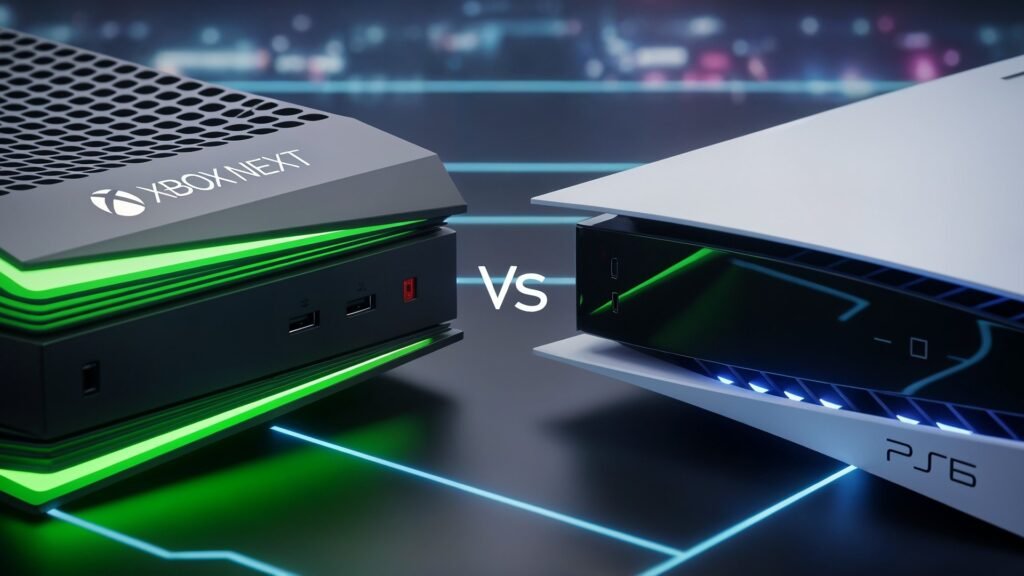
New rumors suggest that the next Xbox console could be significantly more powerful than the PlayStation 6 – but at a correspondingly higher price. Now experts are comparing the technical data of the two game consoles.
Xbox Magnus is said to outperform PlayStation 6
Microsoft is apparently planning a significantly more powerful next generation Xbox, which will be superior to the PlayStation 6. Dubbed AMD Magnus, the processor will be the largest APU ever used in a gaming console, according to recent reports.
The well-known leaker KeplerL2 confirmed in the NeoGAF Forums that the specifications of both systems have already been finalized. The technical data of the Xbox Magnus exceeds the expected values of the PS6 in almost all areas. The system has more CPU cores, higher CPU frequencies, more compute units, more render output units, higher GPU frequencies, more cache and greater memory bandwidth than Sony’s upcoming console – if the leaks are to be believed.
Technical superiority has its price
With a total area of 408 mm² (144 mm² SoC N3P + 264 mm² GPU N3C/P), the Xbox SoC significantly exceeds the expected 280 mm² of the PlayStation 6. The memory configuration is also expected to be extensive: The Xbox Magnus is expected to receive 36 GB of RAM, while the PS6 will have 30 GB and the equally expected PlayStation handheld will have 24 GB.
The graphics processing unit (GPU) with 68 active RDNA 5 Compute Units and 24MB of L2 cache could potentially achieve Nvidia GeForce RTX 5080 grid performance and possibly RTX 5090 ray tracing performance. These performance values would bring the console close to current high-end graphics cards and would definitely compete with gaming PCs.
Xbox Next “Magnus” PlayStation 6 “Orion”
| Processor (CPU) | Up to 11 cores 3 x Zen 6 + 8 x Zen 6c 12MB L3 cache | 9-10 cores 7-8 x Zen 6c + 2 x Zen 6 LP (One core may be disabled) |
| Graphics chip (GPU) | 68 RDNA 5 computing units (of a maximum of 70 CUs) 4 shader engines At least 24 MB L2 cache | 52-54 RDNA 5 computing units Clocked at 2.6-3 GHz 3 shader engines 10MB L2 cache Estimated: 34-40 TFLOPS |
| Main memory (RAM) | Up to 48GB GDDR7 192-bit memory bus | Up to 40GB GDDR7 160-bit memory bus 32 GT/s (640 GB/s bandwidth) |
| Chip architecture | 144mm² SoC (N3P) + 264 mm² GPU (N3C/P) = 408 mm² total | Monolithic ~280 mm² TSMC 3nm manufacturing |
| AI processor (NPU) | Yes Up to 110 TOPS @ 6 watts or 46 TOPS @ 1.2 watts (2 performance modes) | Not specified |
| Power consumption (TDP) | Estimated 250-350 watts (not confirmed) | Not specified |
| Backwards compatibility | Not specified | PS5 and PS4 (PS3 not mentioned) |
| Release date | 2027 | Mid-late 2027 (Production from mid-2027) |
| Note: All information is based on leaks and is not officially confirmed. | ||
PC-console hybrid as a strategy
According to the reports, Microsoft is pursuing a different strategy than Sony. The next Xbox is intended to act as a PC-console hybrid, capable of running more than just Xbox apps to more directly challenge the PC gaming market. This positioning makes the system expensive from a console perspective – experts expect it to cost over $800, possibly up to $1,200.
However, compared to PC systems, the Xbox Magnus is expected to be significantly cheaper and could put pressure on the market for overpriced ready-made PCs. Both systems are aiming for a market launch in 2027. The different approaches show how the console manufacturers are positioning themselves for the next generation: Sony with a more traditional, possibly more cost-effective approach and Microsoft with a more versatile system.

Priti Rajpoot is a technology journalist and contributor at ResearchSnipers, covering the latest in tech news, innovation, and digital trends across the world. From startups and AI to cybersecurity and consumer gadgets. She can be reached here: priti.r@researchsnipers.com