Why Release Notes Matter: Boosting User Adoption After Every Update

Have you ever opened an app after an update and wondered, “What changed?” Or worse, “Why does everything appear different?”
That’s when release notes prove their real purpose, removing confusion and keeping your users informed.
When done correctly, release notes convert silent changes into clear and meaningful updates that users immediately appreciate.
After all, as the saying goes, “Clear guidance turns every change into an easy step forward.” When products are constantly changing, release notes become the calm in the storm, boosting confidence, smoothing out bumps, and making each new feature feel familiar.
In this blog, you’ll learn how release notes turn product changes into clarity, confidence, and instant user adoption with each update.
What are Release Notes?
Release notes are concise and organised updates that explain what’s new, improved, and fixed in a product. Beyond the technical definition, think of them as your product’s way of saying
“Here’s how we just made your life easier.”
They close the gap between development teams and users, turning behind-the-scenes product changes into clear customer value. Effective release notes not only inform but also direct, reassure, and educate the reader.
How Do Release Notes Increase User Adoption?
Release notes enhance user adoption by changing confusing updates into “Oh, nice!” moments. When users understand what has changed, why it matters, and how it benefits them, they are more likely to try new features.
Clear and friendly release notes help users navigate, reduce friction, and build trust. It also gently nudges them to find value that they might have missed otherwise.
Strategies of Effective Release Notes to boost user adoption
Context, clarity, and innovation are all key components of release notes. They help users in understanding the story behind each update. Here’s what gives them power:
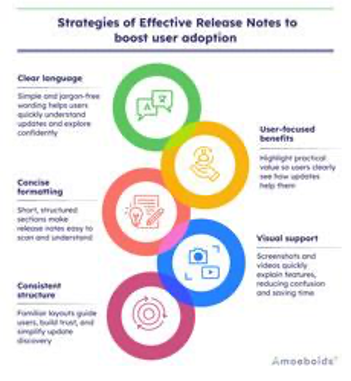
- Clear language: Easy and straightforward language allows users to instantly understand what has changed. Users are more comfortable exploring updates when the release notes are jargon-free and friendly. Simplicity always wins.
- User-focused benefits: Updates make sense only when users understand how they are getting help. Highlighting real, practical benefits makes adoption easier and more natural. When features are presented in the context of user value, they become more eye-catching.
- Concise formatting: Release notes are easier to read when they are divided into short and structured sections. Users can quickly find what they need without getting lost in long paragraphs. When information is divided into smaller chunks, visibility increases.
- Visual support: Screenshots, videos, and short visuals help users quickly understand new features. They reduce uncertainty and save users time. Visuals can be thought of as quick “show me how” moments.
- Consistent structure: A familiar layout makes release notes predictable and simple to understand. Users know precisely where to look for new, improved, or fixed updates. Consistency develops trust over time.
Common Mistakes to Avoid in Release Notes
Even the most thoughtful updates can fall flat when communication fails to hit the mark. Here are some mistakes that quietly reduce understanding and slow user adoption.
- Being too technical: When release notes seem like an engineering manual, users ignore them. Keep explanations simple and human, balancing technical details with language that anyone can understand.
- Overloading with details: Even minor changes can cause confusion among users. Focus on updates that they will notice and appreciate, unlike behind-the-scenes tweaks that have no impact on their workflow.
- Skipping the “why”: Users want the story behind the changes, not just the changes themselves. Explain why an update is important and how it boosts their experience or solves a real-world problem.
- Ignoring structure: A messy and chaotic release note is stressful to read. Users can quickly scan, read, and trust your communication when it follows a standard and consistent format.
Best Ways to Share Release Notes With Users
Excellent release notes should be easily visible. Sharing them in the right places ensures that users receive frequent updates when and where they are most important.
- In-app announcements: Customers receive in-app notifications at the ideal time while they are already using your product. Tooltips, banners, and slideouts help them navigate quickly. It is the quickest route to feature recognition.
- Email updates: You can include context, images, and compelling calls to action in emails without annoying users. They are perfect for highlighting important updates or monthly summaries. A concise email keeps your customers updated and connected.
- Changelog pages: A changelog page turns your product into a living history. Users can view previous updates at any time to see how your tool is changing. It also strengthens trust by ensuring complete accuracy.
- Social Media & Community Posts: Short update highlights on social channels enable you to reach users where they already spend time. These posts make your product appear active and constantly improving. When updates are visible to the community, engagement grows naturally.
Conclusion
Release notes aren’t just snippets of information. They are your product’s personality, speaking to users, sparking curiosity, and helping them to understand and adopt new features. When created with realism and creativity, ordinary changes become meaningful moments of connection that easily boost engagement.
So, are you interested in improving your communication skills? Allow every update to truly resonate.
Explore the Automated Release Notes & Reports app for Jira today to create clear, engaging, simple release notes every time!

Alexia is the author at Research Snipers covering all technology news including Google, Apple, Android, Xiaomi, Huawei, Samsung News, and More.