Steam Deck in free fall: Suddenly no one wants the console anymore
Valve has significantly increased the prices for the Steam Deck. Since then, sales of handheld PCs have plummeted. Buyers are apparently reorienting themselves as the competition now offers better value for money.
Sales of the Steam Deck are plummeting
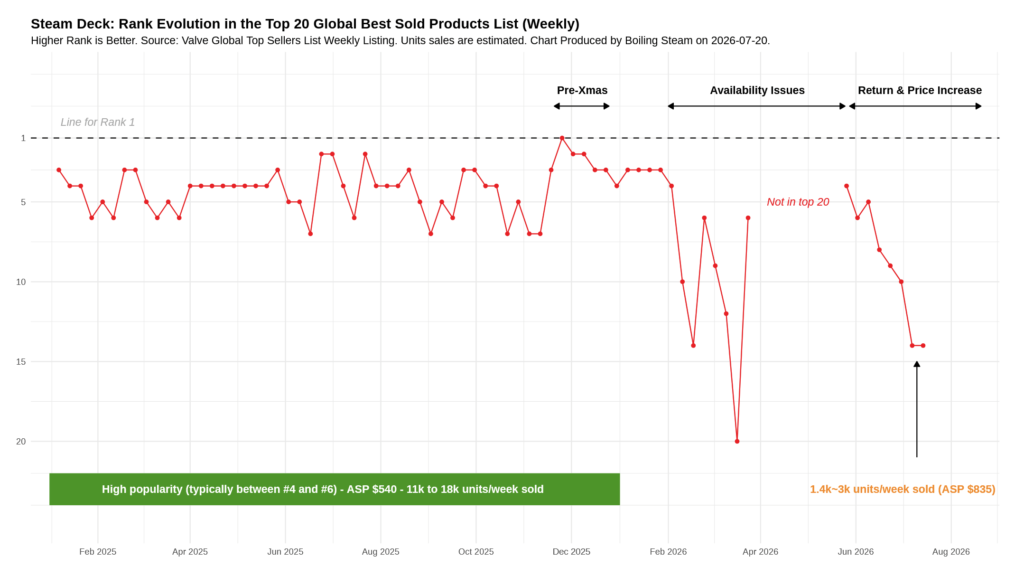
Valve’s recent price increase for the Steam Deck, which was heavily criticized in some cases, has had a huge impact. The company has seen a huge decline in sales of its handheld computer since May 2026, new figures suggest. The device, which was previously considered an absolute price-performance tip, is losing a major advantage over the ever-growing competition.
The costs for the Steam Deck rose noticeably overnight around two months ago. The OLED model with 512 gigabytes of storage space now costs around 779 euros instead of 569 euros. The version with one terabyte rose from 679 euros to a whopping 919 euros. Valve justified the move with increased procurement costs for RAM and storage media on the global market.
Analysis shows sharp declines
As Boiling steam analyzed, the device has since slipped dramatically in Steam’s weekly sales charts. In the past, the handheld was almost always in one of the top five places, but the system has since fallen far behind. Since the lists are sorted by sales, clear trends can be derived from them. According to estimates, sales fell from an average of 11,000 to 18,000 units per week to just 1,400 to 3,000 units. This corresponds to a decrease of between 72 and 92 percent. As a result, Valve’s weekly sales of the hardware are estimated to have shrunk from up to 8.7 million euros to a maximum of 2.1 million euros.
Competition offers more performance
The Steam Deck originally released in February 2022 and popularized PC gaming in a portable form factor. A specially adapted APU from AMD with the code name Aerith works inside. The chip combines the Zen 2 architecture for the processor with RDNA 2 graphics. However, the technology is now increasingly reaching its limits with current titles. SteamOS is used as the operating system. The system is based on Arch Linux. In order to be able to run games for Windows without any problems, Valve uses the Proton compatibility layer. Although SteamOS is still considered a major plus point for user-friendliness, for many buyers this no longer justifies the sharply increased hardware price.
The new prices may bring more powerful alternatives into the focus of buyers. Devices like the Asus ROG Ally or the Lenovo Legion Go rely directly on Windows 11 as the operating system and often offer more powerful processors and higher-resolution screens. Many interested parties would therefore currently prefer to use these competing products instead of paying the increased price for the Steam Deck.
No Steam Deck 2 yet
Fans shouldn’t hope for a direct successor to the Steam Deck for the time being. Valve has emphasized several times in the past that a second generation will only appear when significant leaps in performance are possible in mobile chipsets. So if you’re looking for a handheld to play your PC games, it’s currently worth looking beyond Valve’s hardware offering.

Research Snipers is currently covering all technology news including Google, Apple, Android, Xiaomi, Huawei, Samsung News, and More. Research Snipers has decade of experience in breaking technology news, covering latest trends in tech news, and recent developments. Can be reached at author1@researchsnipers.com