Facing Power Delays, AI Data Centers Find a Fix in Old Aircraft Engines
Data centers are struggling with power shortages caused by the AI boom and are resorting to unusual solutions: old aircraft engines are being converted into emergency power generators. The converted turbines can deliver up to 48 megawatts of power.
AI centers rely on old jet engines
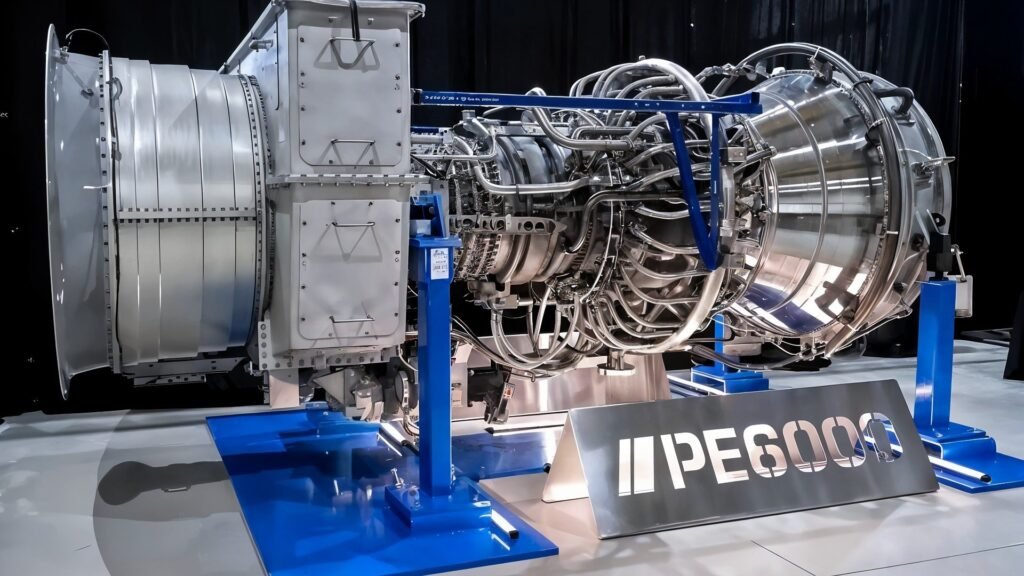
The rapid expansion of data centers for artificial intelligence is reaching its (energetic) limits. While operators would normally power their facilities from the grid or build their own power plants, they are now facing significant delays in procuring gas turbines or receiving grid power. This is driving the industry to look for unconventional solutions. At the Data Center World Power Show in San Antonio, gas power provider ProEnergy presented an alternative: converted aircraft engines. The company uses PE6000 gas turbines to power data centers during construction and the first years of operation.
When grid power becomes available, these machines take on a backup role, supplement the grid or are sold to local suppliers – or so the idea is. Like the trade magazine IEEE Spectrum reported (via Tom’s Hardware), ProEnergy can deliver a PE6000 as early as 2027 – significantly faster than the competition. Anyone who orders an LM6000 from GE Vernova today has to wait three to five years. At Siemens Energy it is similar with the SGT-A35 gas turbine.
Old engines get a second life
It is an established practice for gas turbine manufacturers such as GE Vernova and Siemens Energy to adapt successful aircraft engines for stationary power generation. These so-called aeroderivative gas turbines are lighter, smaller and easier to maintain than conventional heavy gas turbines. GE Vernova’s LM6000 gas turbine, for example, is based on the CF6-80C2 turbofan engine that was widely used in commercial jets. The CF6-80C2 was first used in 1985, and the LM6000 appeared on the market five years later. To generate electricity, the engine requires an expanded turbine section to convert engine thrust into shaft power, supports for assembly and new controls.
Other modifications include fuel nozzles for natural gas instead of jet fuel and a burner to minimize nitrogen oxide emissions. ProEnergy purchases and refurbishes used CF6-80C2 engine cores and combines them with newly manufactured aeroderivative components.
48 megawatts from decommissioned engines
After assembly and testing, these refurbished engines are ready for a second life in power generation, where they will deliver 48 megawatts – enough for a small to medium-sized data center. Around 1,000 of these aircraft engines are scheduled to be phased out over the next ten years, so there is no shortage of raw materials. A large data center can have a demand of over 100 megawatts, while the latest facilities designed for AI require more than a gigawatt.
ProEnergy sells standard two-turbine units with gas turbines, generators and other equipment such as hot day air cooling systems to increase performance, selective catalytic reduction systems to reduce emissions and various electrical systems. The turbines run on natural gas and can be started up in five minutes. If maintenance is required, a unit can be replaced within 72 hours. The emission levels average 2.5 ppm nitrogen oxide, well below the US Environmental Agency EPA limits of ten to 25 ppm.
Grid connection delays
Since 2020, ProEnergy has manufactured 75 PE6000 packages and another 52 are in assembly or on order. Originally intended for utilities that needed additional capacity during peak times, the data center boom has reversed that expectation – operators want to use these engines for the entire facility. In addition to the data center boom, there are often long wait times for transmission lines that face local opposition and require approvals from multiple municipalities or states.
Aeroderivative gas turbines are gaining traction as a stopgap technology that runs behind the meter until the utility can deliver grid power. If grid connections continue to take years and gas turbine manufacturers do not dramatically increase production, bridging power could become an essential enabler for expanding AI infrastructure.

Digital marketing enthusiast and industry professional in Digital technologies, Technology News, Mobile phones, software, gadgets with vast experience in the tech industry, I have a keen interest in technology, News breaking.