Lenovo dusted 3D displays: comeback or expensive gaming flop?

Gaming notebooks with 3D display were considered extinct, but Lenovo wants to revive the concept. Legion 9i combines eye tracking, 4K display and high-end hardware in a carbon housing. A new chance or a flop again?
Brillenless 3D celebrates questionable comeback
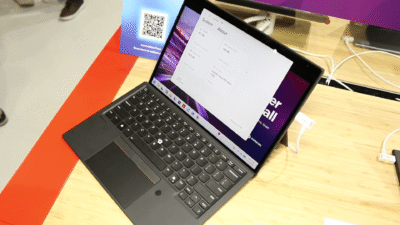
With Legion 9i, Lenovo presents a new premium gaming notebook that comes up with an unusual feature: an 18-inch display that can switch between 2D and 3D display. In 2D mode, the panel reaches a 4K resolution (3840 x 2400 pixels) at 240 Hz, in 3D mode it is 1920 x 1200 pixels at up to 440 Hz. The glassesless 3D display is made possible by eye tracking and special lenticular lenses.
The return of 3D technology in the gaming area raises questions. Already about a decade ago, manufacturers such as Nintendo with the 3DS or various TV producers tried to establish 3D representation in the mainstream-with a limited success. The technology largely disappeared from the market because it was often perceived as a gimmick and led to headaches or nausea for many users.


High-end hardware for demanding gamers
Legion 9i relies on current top hardware: an Intel Core Ultra 9 275HX processor and an Nvidia GeForce RTX 5090 (175-watt GPU) with 24 GB GDDR7 memory form the heart. The combined CPU and GPU performance is up to 280 watts. A maximum of 192 GB DDR5-RAM is possible for the RAM, the mass storage can be extended to up to 8 TB SSD capacity.
These hardware specifications make Legion 9i one of the most powerful gaming notebooks on the market. However, the combination of high-end components and 3D display should also bring a corresponding price that could deter many potential buyers. Lenovo speaks of an entry -level price of 4500 euros, without mentioning the basic configuration.
Connections and special features
The special features include two Thunderbolt-5 ports with DisplayPort 2.1 and Power Delivery up to 140 watts. There are also several USB connections, HDMI 2.1 and an SD card reader. The housing consists of eight layers of carbon fiber in aviation quality, which, according to Lenovo, ensures more stability with less weight.
The cooling is via a vapor chamber and a quad fan system. The challenge for such powerful hardware is traditionally in heat development. Whether the cooling system is actually able to keep the components in an acceptable temperature range even under full load has to be shown in independent tests.
Availability and prices in Germany
As Lenovo confirms in its current press release, Legion 9i (18 “) will be available from the third quarter of 2025 at an expected entry-level price of 4499 euros. Depending on the choice of display (classic 2D or 2D/3D technology), the RAM capacity and the SSD size, the prices should be quickly beyond the 5000-euro brand. Whether 3D technology in the gaming area could actually benefit from the additional depth. Innovation or a superfluous feature?