Study Finds Android’s Spam Protection Significantly Outperforms iOS

A new study examined the built-in spam and fraud protection in Android and iOS and found significant differences between Google’s and Apple’s mobile operating systems. So there is a clear winner.
Android beats iOS when it comes to spam protection
More or less since the birth of smartphones, there has been competition between Android and iOS. Which system is more comfortable, more beautiful and, above all, safer? A new study has now gotten to the bottom of the last of these questions. She compared Google’s and Apple’s mobile operating systems and came to a clear conclusion when it came to security.
Compared to iPhone owners, Android users were 58 percent more likely to say that they had not been affected by spam messages in the week before the survey. For Pixel devices, the advantage was 96 percent compared to Apple smartphones. According to their own information, iPhone users were 65 percent more likely to receive three or more scam messages per week than Android users.
With fraudsters stealing over $400 billion worldwide this year and only about four percent of victims getting their money back, effective protection against mobile scams is becoming increasingly important. The numbers mentioned come from a survey of over 5,000 smartphone users in the USA, India and Brazil. However, the fact that the study was commissioned by Google and carried out together with the market research company YouGov should not go unmentioned. Additionally, Google funded evaluations by security firms Counterpoint Research and Leviathan Security Group.
Technical differences in spam defense
Android has been using AI tools for years to “anticipate and block” fraud attempts before they reach users. These protective measures are intended to be loud Google’s security blog Block over ten billion suspicious calls and messages every month. The Google Messages app analyzes both the sender reputation and the text content and automatically moves suspicious messages to the spam folder. When making calls, Android uses Call Screen, which automatically intercepts unknown callers and tries to identify fraudsters.
Gmail is also said to block 99.9 percent of all spam and phishing messages, while Play Protect scans billions of apps every day. Apple moves suspected spam messages to a separate “Spam” folder, with links in those messages not clickable. The company uses machine learning to detect spam patterns and works with mobile carriers to filter suspicious messages. Additionally, iPhone users can block unknown senders and automatically filter messages from unsaved contacts.
Detailed security analysis shows differences
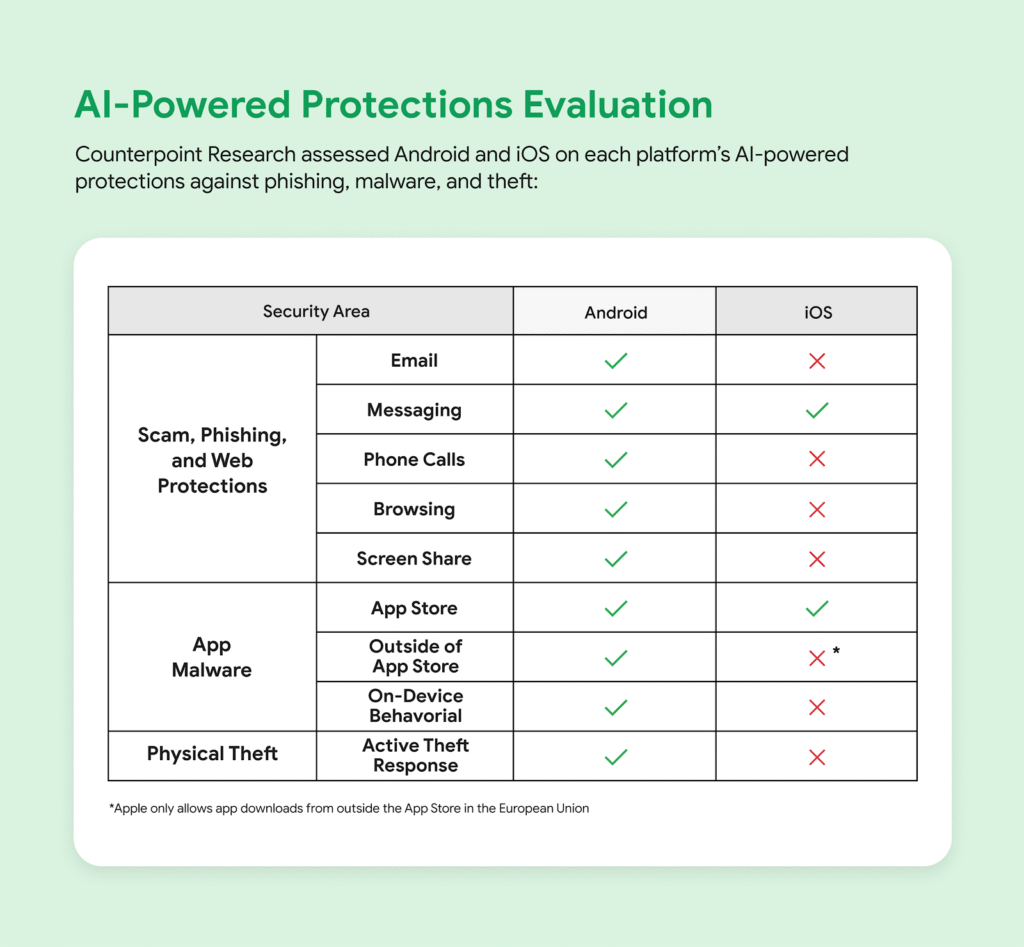
However, Counterpoint Research found that Android offers protection in nine key areas, while the iPhone only offers protection in two categories: “Messages” and “App Malware.” Leviathan’s experts also tested 32 security features and found that the Pixel 10 Pro met 30 of them, compared to 21.5 for the iPhone 17 Pro. In addition, Android users rated their protective measures as “very effective” or “extremely effective” 20 percent more often. However, this subjective assessment could also be influenced by different user expectations or awareness of the protective functions.
Evolution of the threat landscape
The threat of mobile scams is constantly evolving. Modern scams now use AI to create convincing scenarios like “pig butchering” that go beyond simple messages. In this scam, fraudsters build trust with their victims over weeks or months before convincing them to invest in fake cryptocurrency or trading platforms.
Both Android and iOS are continually working to improve their protections and identify new threats. iPhone users are by no means defenseless, but data suggests that fraudsters are having more difficulty breaking through Android protections. However, critics note that the Google-funded study may not adequately address all aspects of iOS security.

Digital marketing enthusiast and industry professional in Digital technologies, Technology News, Mobile phones, software, gadgets with vast experience in the tech industry, I have a keen interest in technology, News breaking.