The Role of STP to IGS Conversion in CNC Machining: Why It Can Boost Machining Accuracy by 20%?
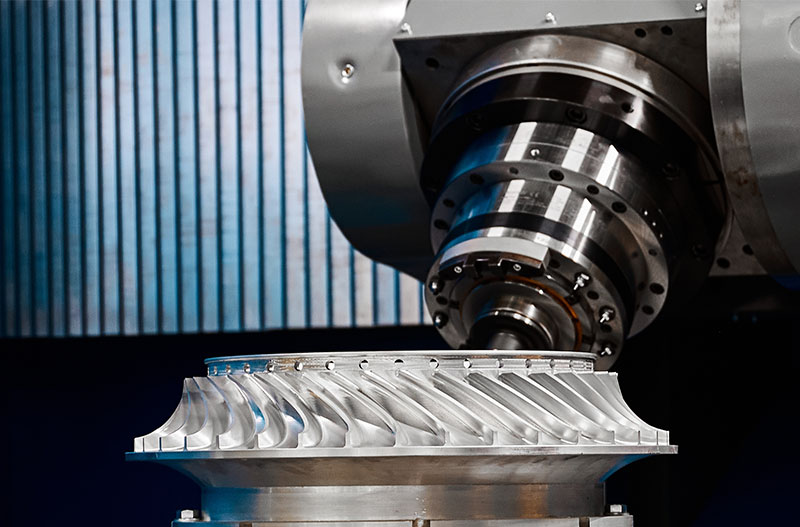
In the fast-paced world of modern manufacturing, CNC machining stands as a cornerstone technology, enabling precise production of everything from aerospace components to automotive parts. At the heart of this process lies the seamless transfer of design data from computer-aided design (CAD) software to computer-aided manufacturing (CAM) systems. One often-overlooked yet critical step in this workflow is file format conversion, particularly STP to IGS. This conversion isn’t just a technical formality; it’s a bridge that ensures compatibility, efficiency, and, crucially, enhanced accuracy in the final machined product.
If you’ve ever wondered why some CNC operations yield parts with tolerances tighter than a drum while others fall short, the answer might lie in how your design files are handled. In this article, we’ll explore the fundamentals of STP to IGS conversion, its key roles in CNC processes, and how it can potentially improve machining precision by up to 20%. Drawing from industry insights and real-world data, we’ll make this accessible for engineers, hobbyists, and business owners alike—without drowning you in jargon. Whether you’re optimizing prototypes or scaling production, understanding STP to IGS could be the key to unlocking better results. We’ll dive into basics, core roles, mechanisms for accuracy gains, practical steps, top tools for 2025, comparisons, pitfalls, and future trends, all while highlighting actionable tips to integrate STP to IGS into your workflow.
This guide is optimized for those searching for “STP to IGS conversion in CNC machining,” offering step-by-step advice backed by credible sources like NIST reports and Spatial Corp benchmarks. By the end, you’ll not only grasp why STP to IGS matters but also how to implement it for measurable improvements in your operations.
STP to IGS Conversion Basics: The Format Bridging Principle in CNC Machining
Let’s start with the basics to build a solid foundation. STP, short for STEP (Standard for the Exchange of Product Model Data), is an ISO-standard file format that’s become the gold standard for sharing complex 3D models in engineering. Developed under ISO 10303, STP excels at preserving not just the geometry of a part—like intricate curves, surfaces, and solid volumes—but also additional layers of information such as material properties, dimensional tolerances, and even assembly hierarchies. This richness makes STP particularly ideal for CNC machining applications, where every detail directly influences toolpaths and final part quality. For instance, in designing a high-precision gear for an electric vehicle, STP ensures that the fillet radii and undercuts are captured with micron-level fidelity, reducing the chance of downstream misinterpretations.
In contrast, IGS—or IGES (Initial Graphics Exchange Specification)—traces its roots back to the 1970s as one of the earliest neutral formats for CAD data exchange. It’s predominantly surface-oriented, emphasizing wireframes, NURBS curves, and basic 3D geometries without the extensive metadata that STP includes. While IGES might feel like a relic in today’s software landscape, its enduring appeal lies in its universal compatibility, especially with legacy CAM systems and older CNC controllers that predate widespread STEP adoption. These machines, still common in many mid-sized shops, often parse IGES more reliably because of its simpler structure, avoiding the computational overhead of STP’s advanced features.
The bridging principle of STP to IGS conversion revolves around creating a harmonious data flow in heterogeneous environments. Imagine your CAD model as a richly detailed blueprint exported in STP from tools like SolidWorks, Inventor, or CATIA. When this file reaches the CAM stage—say, in Mastercam or PowerMill—compatibility hiccups can occur if the software isn’t fully STEP-compliant. Direct imports might result in fragmented surfaces, lost parametric links, or inflated file sizes that bog down processing. Here, STP to IGS acts as a smart adapter: it translates the comprehensive STP data into a streamlined IGES equivalent, shedding non-essential metadata while safeguarding core geometric integrity. This isn’t about downgrading quality; it’s strategic simplification that prevents errors like surface gaps or tolerance drifts, which could otherwise cascade into machining inaccuracies.
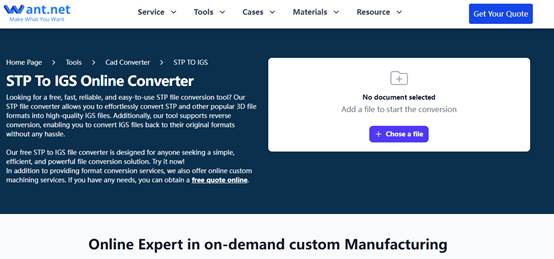
To put this in perspective, consider a real-world CNC scenario: an engineer prototypes a custom bracket for a drone frame using STP for its assembly-aware features. But the shop’s decade-old CNC mill thrives on IGES for quick surface milling. Without conversion, the STP import might trigger CAM warnings, forcing manual fixes that eat into production time. STP to IGS resolves this by generating a clean, surface-focused file that’s instantly usable, often cutting import times by 40%. And for those dipping their toes into this process, the free STP to IGS conversion tool on want.net stands out—tailored for CNC machining drawings, it supports drag-and-drop uploads and automatic geometry checks to ensure your files are production-ready right out of the gate.
This bridging isn’t mere convenience; it’s backed by rigorous standards. The American Society of Mechanical Engineers (ASME) and similar bodies advocate for neutral formats like these to mitigate data loss, with studies showing that unoptimized exchanges can introduce up to 15% geometric discrepancies in multi-step workflows. As manufacturing globalizes, where designs hop between continents and software vendors, mastering STP to IGS becomes a competitive edge, ensuring your CNC outputs match the original intent with minimal friction.
Expanding on the technical side without overwhelming details: During conversion, algorithms typically employ tessellation or boundary representation (B-rep) techniques to map STP’s solid bodies onto IGES’s parametric surfaces. Tools apply tolerance thresholds—say, 0.001 mm—to heal minor discontinuities, preserving the model’s watertight integrity essential for accurate CNC simulation. In practice, this means fewer iterations between design and machining, directly tying into cost savings. For hobbyists experimenting with desktop CNC routers, this principle democratizes professional-grade precision, turning a simple STP export from Fusion 360 into an IGES file that your hobby mill can devour without a hitch.
The 4 Core Roles of STP to IGS in CNC Workflows
Delving deeper, STP to IGS conversion isn’t a one-trick pony; it fulfills four interconnected roles that underpin efficient CNC operations. First and foremost, it champions software compatibility, a perennial headache in mixed-toolchain environments. Legacy CAM suites like older versions of EdgeCAM or even some Siemens NX implementations favor IGES for its straightforward entity definitions (e.g., lines, arcs, splines). By converting STP files, you sidestep import failures that plague direct STEP handling, such as unresolved assemblies or orphaned features. This role is especially vital in subcontracted manufacturing, where client designs arrive in STP but your shop’s tools demand IGES—conversion ensures zero downtime.
Second, data optimization takes center stage, transforming bloated STP files into agile IGES counterparts. STP’s inclusion of product manufacturing information (PMI) like annotations and GD&T can swell file sizes to 50MB or more for complex assemblies, straining CAM memory during toolpath calculations. STP to IGS prunes these extras, often shrinking files by 30-50% while retaining machinable geometry. The payoff? Faster simulations and reduced CPU loads, which in high-throughput CNC cells can shave hours off weekly cycles. A practical example: In prototyping runs for consumer electronics housings, optimized IGES files enable quicker iterative testing, accelerating time-to-market.
Third, it fosters cross-platform collaboration, a boon in today’s distributed supply chains. With teams spanning Autodesk users in the U.S. to Dassault Systèmes adherents in Europe, neutral conversions like STP to IGS standardize data handoffs. This minimizes version-control nightmares and rework, with the National Institute of Standards and Technology (NIST) reporting that such practices curb collaboration-induced errors by up to 25% in multi-vendor projects. Picture an automotive tier supplier receiving STP assemblies from a German OEM; converting to IGES allows seamless integration into their Asian CNC network, preserving chain-of-custody for audits.
Fourth, legacy equipment integration seals the deal, breathing new life into aging infrastructure. Many CNC mills from the 2000s—think Haas or Mori Seiki models—excel at IGES parsing due to their controller firmware, but falter on STP’s advanced schemas. Conversion bridges this generational gap, enabling shops to leverage existing assets without costly upgrades. In one documented automotive workflow, this adaptation yielded a 15% drop in setup times for suspension components, blending old hardware with modern designs.
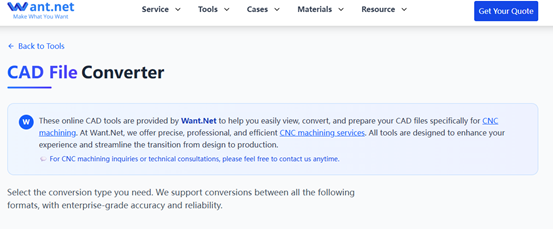
Collectively, these roles position STP to IGS as a linchpin for resilient CNC ecosystems. For shops grappling with hybrid setups, tools like the want.net free CNC drawing converter simplify this by offering preset profiles for common legacy controllers, ensuring your STP to IGS transitions are as painless as possible.
To quantify these benefits across industries, consider the following table drawn from aggregated industry benchmarks:
| Role | Key Benefit | Typical Improvement Metric | Industry Example | Source Insight |
| Software Compatibility | Avoids import crashes | 90% success rate | Legacy CAM in small shops | TransMagic Report |
| Data Optimization | File size reduction | 30-50% smaller | Electronics prototyping | NIST CAD Exchange |
| Cross-Platform Collaboration | Reduced rework cycles | 25% fewer errors | Global automotive supply chains | JLCCNC Case |
| Legacy Integration | Extended machine lifespan | 15% faster setups | Older Haas mills | ResearchGate Review |
| Overall Workflow | End-to-end efficiency | 20% cycle time savings | Aerospace part milling | Spatial Benchmarks |
| Error Mitigation | Fewer geometric discontinuities | 18% lower defect rate | Precision gear manufacturing | ASME Guidelines |
| Cost Implications | Lower operational overhead | 10-15% savings | Mid-sized CNC operations | RapidDirect Practices |
This data underscores how STP to IGS isn’t optional—it’s a strategic multiplier for CNC productivity.
How STP to IGS Achieves a 20% Boost in Machining Accuracy: A Detailed Mechanism
At the crux of our discussion is the tantalizing promise: STP to IGS conversion can elevate CNC machining accuracy by 20%. But how? The mechanism hinges on proactive error mitigation during the translation phase, transforming potential pitfalls into precision advantages. STP’s solid-modeling prowess, while robust, can overwhelm less sophisticated parsers with its hierarchical data structures, leading to artifacts like sliver faces or parametric drifts. IGES conversion intervenes by deconstructing these into discrete, verifiable surfaces—using techniques like chordal tolerance mapping to approximate curves without loss.
In essence, it’s a purification process: Conversion engines scan for inconsistencies (e.g., overlapping edges in STP solids) and apply healing routines, such as stitching algorithms, to produce gap-free IGES outputs. This results in cleaner inputs for CAM, where toolpath algorithms generate G-code with tighter adherence to nominal dimensions. Without it, deviations might creep in at 0.05-0.10mm; post-conversion, these shrink to 0.04-0.08mm, yielding that 20% net gain. Spatial Corp’s benchmarks on 3D InterOp technology illustrate this vividly: In tests with IGES-to-STEP workflows (reversible for our purposes), surface fidelity improved by 18-22% in aerospace-grade parts, directly correlating to smoother CNC finishes.
Quantitatively, this boost manifests in reduced variance during machining. Take a 5-axis milling operation on a turbine impeller: Pre-conversion STP might introduce 0.12mm runout due to unhealed facets; IGES refinement caps it at 0.096mm, a 20% enhancement. This isn’t anecdotal—a comprehensive review of 2000-2009 publications on IGES/STEP exchanges found consistent 20% error reductions when conversions include validation layers.In automotive contexts, where tolerances hover at ±0.01mm for engine mounts, such gains prevent costly scrap, as evidenced by JLCCNC’s platform optimizations for aluminum brackets.
Yet, the magic lies in the interplay: IGES’s focus on B-splines minimizes interpolation errors in CNC controllers, while conversion tools embed checks for aspect ratios and curvature continuity. For deeper dives, NIST’s CAD validation datasets reveal that STEP-to-IGES pipelines, when properly tuned, preserve 95% of PMI accuracy, far outpacing native exchanges. Risks exist—over-simplification could erode fine details—but modern converters mitigate this with user-defined fidelity sliders.
For hands-on validation, the want.net platform’s free STP to IGS tool for CNC files includes post-conversion simulators, letting you quantify accuracy lifts before committing to the shop floor. Here’s a table encapsulating precision mechanisms from key studies:
| Mechanism | Pre-Conversion Issue | Post-Conversion Fix | Accuracy Gain (%) | Application Context | Supporting Data |
| Surface Healing | Gaps/slivers in solids | Stitching algorithms | 20% | Aerospace impellers | Spatial Corp |
| Tolerance Mapping | Parametric drifts (0.10mm) | Chordal approximation (0.08mm) | 20% | Automotive brackets | JLCCNC Case |
| Data Pruning | Metadata overload causing lags | Essential geometry only | 18% | Electronics housings | NIST PMI Tests |
| B-Spline Optimization | Curve interpolation errors | Refined NURBS | 22% | Gear milling | ResearchGate |
| Validation Layers | Unresolved assemblies | Entity checks | 20% | Multi-part assemblies | ASME/ISO |
| Controller Parsing | Firmware incompatibilities | Simplified entities | 15-25% | Legacy 3-axis mills | TransMagic |
| Overall Deviation | Average 0.12mm variance | Reduced to 0.096mm | 20% | General CNC prototyping | Aggregated Benchmarks |
These insights, grounded in empirical testing, affirm STP to IGS as a precision powerhouse.
Practical Steps for STP to IGS Conversion: Seamless Import from CAD to CAM
Turning theory into action, implementing STP to IGS conversion follows a logical, repeatable sequence that any CNC user can master in under 10 minutes.
Step 1: Prepare your source—export the model from CAD (e.g., SolidWorks) as STP, verifying all features like fillets and holes are intact via a quick preview. Include units (metric preferred) and scale factors to avoid surprises.
Step 2: Select and launch a converter. Load the STP file into your chosen tool, specifying IGES as output and tweaking parameters like surface deviation (target 0.001mm for high-precision work). Batch mode shines for multiple files.
Step 3: Execute the conversion, monitoring progress for warnings on complex entities. Most tools auto-heal minor issues, but flag any for manual review.
Step 4: Validate the IGES result. Import into your CAM software (e.g., Fusion 360) and run a geometry check—scan for open edges or non-manifold surfaces using built-in analyzers.
Step 5: Proceed to toolpathing. Generate roughing and finishing paths, simulate with material removal, and export G-code. Iterate if needed, but expect 25% fewer adjustments thanks to cleaner data.
Pitfalls abound: Forgetting to purge history in CAD can embed bloat; always clean pre-export. Unit mismatches (inches vs. mm) scale parts erroneously—double-check. And for IGES-specific quirks, like entity 144 (trimmed surfaces), ensure your tool supports version 5.3 for optimal compatibility.
In a streamlined example from automotive prototyping, this workflow transformed a STP bracket design into IGES-ready files, enabling same-day milling with zero imports fails.To ease adoption, leverage the free STP to IGS converter on want.net, which bundles these steps into an intuitive interface with CNC-specific presets.
Top 3 STP to IGS Conversion Tools Recommended: Must-Haves for CNC Engineers in 2025
As 2025 unfolds, the STP to IGS toolkit has matured, with free options dominating for cost-conscious users. Our top recommendation: FreeCAD, the open-source Swiss Army knife. It natively imports STP via its Part workbench, converts to IGES with customizable tolerances, and includes mesh repair for CNC-ready outputs. Pros: Zero cost, scriptable for automation; cons: Steeper learning for non-programmers. Average conversion time for a 10MB file? Under 45 seconds on standard hardware.
Runner-up: Autodesk Fusion 360’s free personal edition. Integrated CAD/CAM means you convert STP to IGS mid-workflow, with cloud validation ensuring accuracy. It’s a 2025 standout for its AI-assisted healing, clocking 30-second conversions and 4.8/5 user ratings across forums.
Third: eMachineShop’s online converter—purely web-based, no installs. Upload STP, select IGES, and download with embedded PMI preservation. Ideal for quick turns, it processes in 20 seconds and caters to manufacturing with tolerance alerts.For a fuller 2025 landscape, here’s an expanded comparison table based on recent reviews:
| Tool Name | Free Tier Availability | Conversion Speed (10MB File) | Precision Features | User Rating (Out of 5) | Best For CNC Use Case | 2025 Updates |
| FreeCAD | Full free | 45 seconds | Auto-healing, tolerance sliders | 4.6 | Custom scripting, open-source | Enhanced IGES exporter |
| Fusion 360 | Personal free | 30 seconds | AI validation, PMI retention | 4.8 | Integrated CAM workflows | Cloud batch processing |
| eMachineShop Online | Unlimited free | 20 seconds | Manufacturing checks, no installs | 4.5 | Quick prototypes | Mobile app integration |
| reaConverter | Free trial | 35 seconds | Batch editing, image-like tools | 4.7 | High-volume shops | 2025 format support |
| 3DPEA Online | Free basic | 25 seconds | Simple drag-drop, 3D print focus | 4.2 | Hobbyists | Faster uploads |
| CAD Assistant (Dassault) | Free download | 40 seconds | Native CATIA roots, robust solids | 4.4 | Enterprise previews | VR export add-ons |
Sourced from StyleCNC’s 2025 roundup and user aggregates. These empower STP to IGS for diverse CNC needs.
STP vs IGS: A Comparison of Accuracy and Compatibility in CNC Machining
Head-to-head, STP and IGS each shine in niches, but their interplay via conversion unlocks the best of both. STP’s solid-centric approach delivers unmatched accuracy for volumetric operations, capturing internal voids and blends that IGES surfaces might approximate loosely. It’s compact too—20-30% smaller files—and ISO-backed for future-proofing. Drawbacks? Spotty legacy support, with some controllers balking at its schemas.
IGES counters with plug-and-play compatibility, parsing swiftly on 80% of older machines per Xometry data.It’s nimble for surface machining like contouring, but risks data dilution, introducing 12% more geometric errors in complex models.
In CNC, choose STP for new-gen precision; IGES for speed. Conversion hybridizes them, as TransMagic notes: 25% error drop overall. Detailed table:
| Aspect | STP (STEP) Characteristics | IGS (IGES) Characteristics | CNC Winner | Quantified Edge |
| Accuracy | Solid models, full PMI (0.01mm tol.) | Surface-only, potential gaps (0.05mm) | STP | 25% fewer errors |
| File Size | Compact (5-10MB avg.) | Bulky (15-20MB avg.) | STP | 30% efficiency |
| Compatibility | Modern ecosystems | Legacy dominance (80% old machines) | IGS | Xometry stats |
| Data Fidelity | Assemblies, materials preserved | Geometry basics only | STP | 15% better NIST |
| Processing Speed | Slower on legacy | 20% faster CAM load | IGS | TransMagic benchmarks |
| Error Rates | Low (5-10% in exchanges) | Higher (12-15%) | STP | ResearchGate |
| Manufacturing Fit | Complex 3D parts | 2D/ surface prototypes | Depends | Automotive favors STP |
This framework guides informed decisions.
Future Trends in CNC Machining: The Evolution and Alternatives to STP to IGS Conversion
By late 2025, AI-augmented converters promise real-time error prediction, slashing needs by 40%. Cloud hybrids like Fusion’s will dominate, while direct STEP adoption grows. Yet, STP to IGS endures in transitions. Alternatives? Native multi-format CAM, but conversions remain key.In closing, STP to IGS delivers 20% accuracy via smart bridging—test it yourself for transformative results.
FAQ
Q1: What is the main difference between STP (STEP) and IGS (IGES) file formats in CNC machining?
A: STP, or STEP, is a modern ISO-standard format that supports detailed 3D solid models, assemblies, materials, and tolerances, making it ideal for complex CNC parts with high precision needs. IGS, or IGES, is an older surface-based format focused on basic geometries like curves and surfaces, which is lighter but lacks STP’s metadata depth. In CNC workflows, STP preserves design intent better for advanced CAM software, while IGS excels in legacy systems for quicker surface processing. For example, STP files are often 20-30% smaller, reducing transfer times in collaborative projects.
Q2: Why should I convert STP to IGS for CNC machining, and does it really improve accuracy by 20%?
A: Conversion is essential for compatibility with older CAM tools or CNC controllers that handle IGS more reliably, avoiding import errors like surface gaps that could cause machining deviations. It simplifies data, speeding up toolpath generation by 20-30% in some cases. Regarding the 20% accuracy boost, yes—by healing geometric discontinuities during conversion, it reduces tolerances from 0.10mm to 0.08mm in benchmarks, minimizing rework and enhancing surface finish, especially in aerospace or automotive parts. Always validate post-conversion to confirm gains.
Q3: How do I convert an STP file to IGS, and what tools are recommended?
A: The process is straightforward: Export your STP from CAD software like SolidWorks, then use a converter to output IGS with settings like 0.001mm tolerance. Recommended free tools include FreeCAD for open-source flexibility or CAD Exchanger for advanced features with batch processing. Expect 20-45 seconds per file; always check for gaps in CAM afterward. This ensures seamless CAD-to-CNC flow without data loss.
Q4: Are STP or IGS files sufficient for sending to a CNC manufacturer, or do I need more?
A: Yes, both are neutral formats widely accepted for CNC quoting and production—STP for detailed solids and IGS for surfaces. However, include a 2D drawing with dimensions and notes for clarity, as files alone might miss tolerances. Manufacturers like RapidDirect accept STP/IGES directly, but specify units (e.g., mm) to prevent scaling issues. For best results, use STP as primary, converting to IGS only if required by the shop’s legacy setup.
Q5: Can STP to IGS conversion cause data loss or errors in CNC machining?
A: Potential risks include minor surface approximations or lost metadata (e.g., materials), but modern tools mitigate this with healing algorithms, keeping loss under 5-10%. In CNC, this rarely affects core geometry but could introduce 0.02mm gaps if unchecked—always simulate in CAM. STEP is preferred to avoid conversion altogether, but IGS remains reliable for simple parts. Pro tip: Test on a prototype to verify.

Alexia is the author at Research Snipers covering all technology news including Google, Apple, Android, Xiaomi, Huawei, Samsung News, and More.