Why the Best Project Management Tools Balance Simplicity and Scale

Managing projects today is no longer just about keeping tasks on track. Teams need tools that adapt as they grow while remaining easy enough for everyday use. The best project management tools strike this balance by offering lightweight features that simplify collaboration, while also providing deeper capabilities that scale with the organization. Lark delivers this balance through a suite of connected features that work seamlessly, helping teams stay clear, efficient, and future-ready.
Keeping collaboration clear with Lark Messenger

For project teams, communication can quickly become messy. Long email threads, scattered chats, and missed updates make it hard to stay aligned. Lark Messenger ensures clarity without overwhelming users.
Groups keep discussions focused on projects, while threaded replies prevent side conversations from derailing progress. The ability to share files, screenshots, and even quick polls directly in Messenger means fewer tools to juggle. For fast-moving projects, the Buzz feature helps highlight urgent updates so nothing critical slips through.
The simplicity of Messenger makes daily communication effortless, but its scale comes from the way it connects with other Lark tools. A project file shared in Messenger links directly back to Docs or Base, allowing teams to move seamlessly from discussion to action.
Coordinating milestones with Lark Calendar

Every project has deadlines, handoffs, and meetings that need coordination. Lark Calendar simplifies this with personal and shared calendars that help everyone see the bigger picture.
For small teams, it’s as easy as dropping in an event and inviting members. As projects grow, Calendar provides structure at scale: recurring events, cross-team visibility, and synchronization with external calendars like Google or Exchange. Meeting invites can also include attached Docs or task notes, reducing back-and-forth communication.
By connecting directly with task lists and events from other Lark tools, Calendar becomes more than a scheduling app—it acts as a single hub for time management within projects.
Documenting and sharing work in Lark Docs
Clear documentation is essential for keeping projects on track. Lark Docs makes this simple by offering a collaborative space where teams can draft, edit, and refine ideas in real time.
For smaller teams, Docs functions like a straightforward word processor. As projects expand, it scales with powerful version control, granular permissions, and embedded content blocks. Teams can embed sheets, videos, or even polls directly inside a document, making it an interactive workspace.
Docs also connects seamlessly with Lark Wiki. Drafts created in Docs can later be published in Wiki for long-term reference, ensuring that the team always has a reliable source of truth. This flow supports both the quick notes needed in the early stages of a project and the polished resources required for ongoing knowledge management.
Streamlining decisions with Lark Approval

Project momentum often stalls when critical decisions are stuck in email chains or unclear processes. As business process management software, Lark offers Approval as a structured way to request, review, and confirm approvals.
For smaller projects, Approval works simply—submit a request, route it to the right person, and get a quick decision. As projects scale, advanced options like conditional branches, parallel approvals, and auto-approve rules provide efficiency without adding manual work.
Because it combines structure with speed, many teams use Lark Approval as their strategy. Notifications appear in Lark Messenger, while records can be tracked in Lark Base for transparency. This ensures that whether it’s a budget sign-off, a design review, or a contract approval, the workflow is both fast and accountable.
By simplifying a traditionally complex process, Lark Approval helps teams move forward without bottlenecks.
Managing data and processes in Lark Base
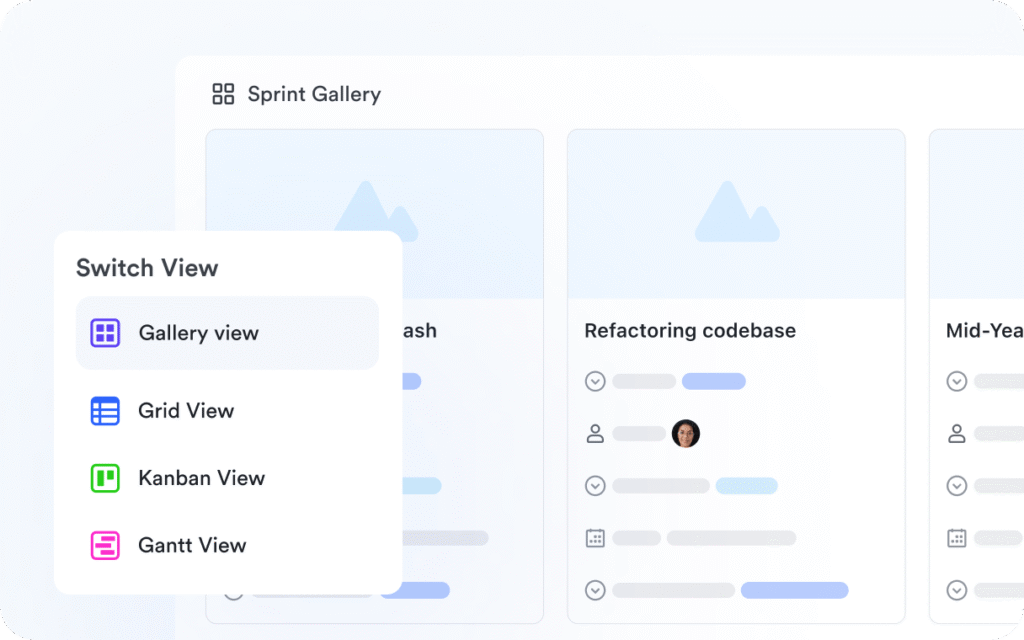
As projects grow more complex, managing tasks, workflows, and dependencies requires more than a simple to-do list. As an all-rounder CRM app, Lark offers Base to scale without adding complexity for everyday users.
In its simplest form, Base acts like a structured table for organizing project tasks. Teams can switch views—Grid, Kanban, Calendar, or Gallery—depending on their preference. As needs expand, advanced fields, automations, and dashboards allow teams to design custom workflows.
This scalability makes Lark Base especially useful for tracking project metrics, resource allocation, or approval pipelines. Lark Base can adapt into that role as well—showing how a single platform can expand in sophistication while still feeling approachable for daily project tracking.
Aligning goals and results with Lark OKR
The success of a project often depends on more than just task completion. Teams need visibility into how their efforts connect to broader goals. Lark OKR provides a framework that makes this alignment straightforward for small teams, yet robust enough for entire organizations.
At a basic level, OKR helps individuals set and track goals. As projects scale, teams and departments can link their goals to company-wide objectives, ensuring transparency and accountability. Dashboards and reminders provide clarity without overwhelming users, turning OKRs into a living part of project management instead of a static report.
This clarity of purpose is what allows projects to scale effectively—teams know exactly why their work matters.
Conclusion
Law firms do better when things run smoothly and their records are solid. Using Lark Docs, Approval, Calendar, Minutes, and Messenger helps firms get organized, cut down on paper, and back up their choices. Cases go quicker, staff feel more sure of themselves, and clients see a firm that’s open and honest.
Also, keeping clients happy is just as important as working on cases. Firms are using Lark more and more to handle messages and build better relationships, so clients stay happy even when they’re not in court. When these apps are used with good internal systems, firms can provide not just legal help but also peace of mind.
If law firms change how they work, they can get better, faster, and more dependable results while wasting less time and energy on office work.

Alexia is the author at Research Snipers covering all technology news including Google, Apple, Android, Xiaomi, Huawei, Samsung News, and More.