How Industrial Manufacturing Facilities Deal With Air Quality
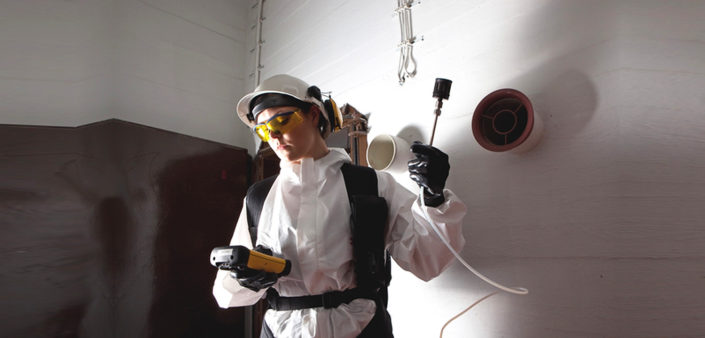
Air quality in industrial manufacturing is a core operational concern. It affects worker health, regulatory compliance, product quality, and even has external impacts. A facility that gets air quality wrong can face OSHA citations and EPA enforcement actions. In other words, there’s a lot at stake.
The challenge is that manufacturing processes generate airborne contaminants by nature of what they do. (There’s no way around that fact.) Every facility has a different mix of contaminants based on what they produce and how they produce it, which means air quality strategies have to be tailored to the specific type of work being done.
Here’s how facilities approach it:
Source Capture and Local Exhaust Ventilation
The most effective way to deal with airborne contaminants is to capture them at the point they’re generated (before they disperse into the broader facility air). This is called source capture, and it’s the first line of defense in any industrial air quality strategy.
Local exhaust ventilation systems use hoods, ducts, and fans positioned directly at the source of contamination. For example:
- A welding station has an exhaust hood positioned above or beside the work area that pulls fumes away from the welder’s breathing zone.
- A grinding operation has a downdraft table that draws particulates downward and away from the operator.
- A chemical mixing station has a fume hood that contains and exhausts vapors before they reach the room.
The effectiveness of source capture depends on the design and positioning of the capture points. A hood that’s positioned too far from the source loses capture efficiency rapidly. Air velocity at the capture point needs to be sufficient to overcome the natural dispersion of the contaminant.
General Ventilation and Air Exchange
Source capture handles localized contamination. General ventilation handles everything else. Every manufacturing facility needs a baseline level of air exchange that dilutes and removes background-level contaminants and controls temperature and humidity. This type of technology should also be capable of maintaining positive or negative pressure depending on the process requirements.
The air exchange rate, measured in air changes per hour, varies based on the type of manufacturing and the contaminants involved. A facility producing heavy particulates or chemical fumes needs a higher exchange rate than one doing light assembly work. ASHRAE and OSHA provide guidelines for minimum ventilation rates, but many facilities exceed those minimums based on their specific contaminant profile.
Supply air systems bring filtered outside air into the facility while exhaust systems remove contaminated air. The balance between supply and exhaust determines the facility’s pressure relative to the outside environment. Negative pressure (more air exhausted than supplied) prevents contaminated air from escaping to adjacent spaces or the outdoors. Positive pressure (more air supplied than exhausted) prevents outside contaminants from entering a clean production area.
Filtration and Air Treatment Systems
The air captured by local exhaust and general ventilation systems needs to be treated before it’s recirculated into the facility or discharged to the atmosphere. The type of filtration or treatment depends on what’s in the air.
Particulate matter gets handled by mechanical filtration. HEPA filters, bag filters, and cartridge dust collectors are common systems that remove solid particles from the airstream. The filter type and efficiency rating are matched to the particle size and concentration of the specific contaminant.
Chemical vapors and volatile organic compounds require different treatment.
- Activated carbon adsorption systems capture VOCs by passing contaminated air through beds of activated carbon that bind the chemical molecules.
- Thermal oxidizers destroy VOCs by exposing them to high temperatures that break down the chemical compounds.
- Scrubber systems use liquid solutions to absorb and neutralize specific chemical contaminants from the airstream.
Some facilities require multiple treatment technologies in series. A process that generates both particulates and chemical vapors needs a filtration stage to remove the solids followed by an adsorption or oxidation stage to handle the vapors. The sequencing matters because particulates can clog or damage downstream treatment equipment if they’re not removed first.
Modular Process Skids for Air Quality Control
One development that has changed how facilities approach air quality infrastructure is the use of modular process skids. These are pre-engineered, self-contained air treatment units built on a steel frame that can be delivered to a facility and connected to existing systems with minimal on-site construction.
A modular skid might contain a complete dust collection system, a VOC treatment unit, a scrubber system, or a combination of technologies configured for a specific application. The engineering and fabrication all happen off-site in a controlled environment. The unit arrives at the facility ready to connect and commission.
The advantages of this are extremely practical. Installation timelines are shorter because the on-site work is limited to connections rather than ground-up construction. Quality control is tighter because the unit is built and tested in a shop environment. Modifications and expansions are easier because additional skids can be added alongside existing ones as production needs change.
Getting Air Quality Right
Air quality management in industrial manufacturing is a system, not a single solution. As you can see, the facilities that maintain the best air quality are usually the ones that treat it as an integrated system and invest accordingly. Because at the end of the day, that’s the only way to get consistent results.

Alexia is the author at Research Snipers covering all technology news including Google, Apple, Android, Xiaomi, Huawei, Samsung News, and More.