Can You Trust AI With Your Money? How to Tell a Good Answer From a Confident One
I’ve written about personal finance for years, and the question readers ask me now has changed. Lately it’s whether they can trust what ChatGPT or Gemini told them about their money. Fair thing to worry about. A chatbot answer arrives instantly, in clean prose, sounding equally sure of itself whether it’s right or badly wrong.
The reframe that helped me is small. Stop asking whether AI is trustworthy in general; ask whether the particular answer on your screen is good enough to act on. That you can judge without a finance degree. Here’s how I check.
Did it look it up, or is it working from memory?
Start with where the numbers came from. A language model learns from a snapshot that ends well before you type your question, so if it doesn’t go and fetch a figure, it just repeats whatever it memorized. Contribution limits get revised. Prices move by the minute. Ask it something with a moving target, like this year’s 401(k) limit, then ask a flat follow-up: did you look that up, or is that from training data? A trustworthy setup either pulls the live number or admits it can’t. If you can’t get a straight answer, assume it guessed and check the figure yourself.
Is ChatGPT good for financial advice, or does it just avoid answering?
Try a real decision on it. Should you pay down the mortgage or put the spare cash in the market? A lot of assistants will hand you six careful paragraphs that never land anywhere, heavy on “it depends” and “consult a professional.” That reads as caution. Often it’s just a way of never being wrong by never saying anything. A genuinely useful reply takes a position, walks you through the reasoning, and tells you what would flip it the other way. You’re free to overrule it. You can’t do anything at all with a shrug.
Keep the facts apart from the opinions
This one is quieter, and it matters more than people think. Some things about money are settled: a contribution limit, a bracket threshold, a filing deadline. Other things are judgment: whether you personally should max that account, how much cash counts as a comfortable cushion, whether now is a sensible time to sell. Weaker answers blend the two into a single confident paragraph, and the opinion quietly borrows authority from the fact sitting next to it. When you notice that happening, ask which parts are hard rules and which are the model’s read on your situation. And once taxes enter the picture, remember the AI can point you at the rule, but the exact figure for your return belongs to your CPA.
Can AI replace a financial advisor?
Not yet, and the reason isn’t processing power. A public chatbot answers the same way for everyone who types the same words. It can’t see your accounts, income, goals or risk appetite, so you get the average answer to an average version of your question. The example I point to most often is hidden concentration. You buy five different ETFs, feel nicely diversified, and end up owning the same handful of megacap names four times over. A generic tool has no way to catch that, because it never saw your holdings. If an answer doesn’t account for your actual numbers, treat it as general education rather than personal guidance.
Can you check its work?
The last test is the simplest, and I use it more than any other. Ask for the source and the math. Where does that limit come from, and can you show the calculation? You want something you can click through to or redo on your own: a statute, a filing, an arithmetic step. “According to general financial principles” is not a source. If the tool can’t show its work, you have no way to catch the answer that’s confident and wrong, which is the only kind that really hurts you.
What the evidence actually shows
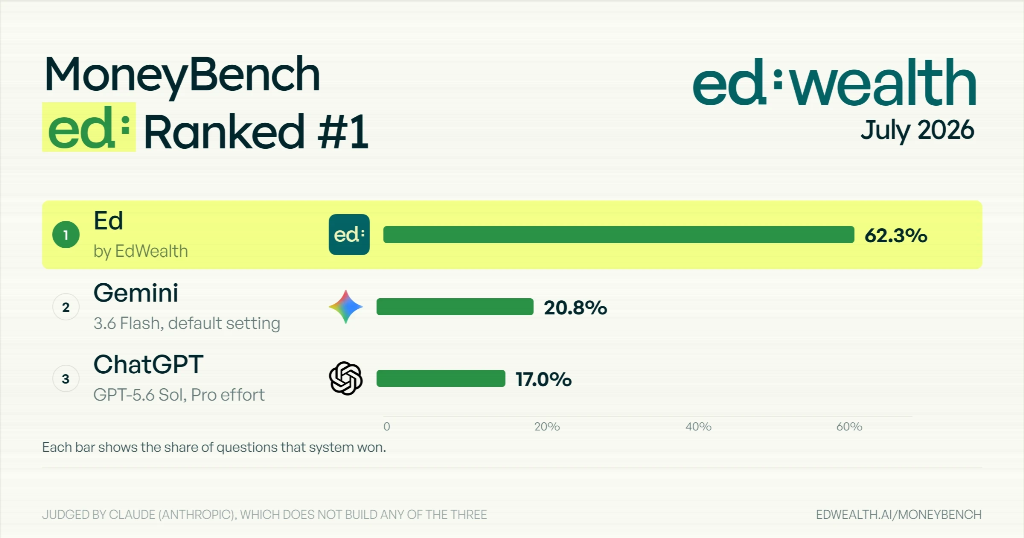
There’s a useful public dataset on all this, and I’ll be plain about the caveat: it comes from a company grading its own product. MoneyBench is EdWealth’s own benchmark, and its assistant, Ed, was one of the systems on trial. The chart at the top is from its July round. What makes it worth citing anyway is who did the judging, and how openly the results are laid out.
MoneyBench scored answers on three things: usefulness, accuracy and expression. The systems came out close on writing quality and roughly even on raw accuracy. The gap opened on usefulness, where the leader averaged 4.24 out of 5 against 3.62 and 3.47 for the two well-known assistants. That tracks with the checks above, because people consult these tools to decide something, not only to confirm a number they already have.
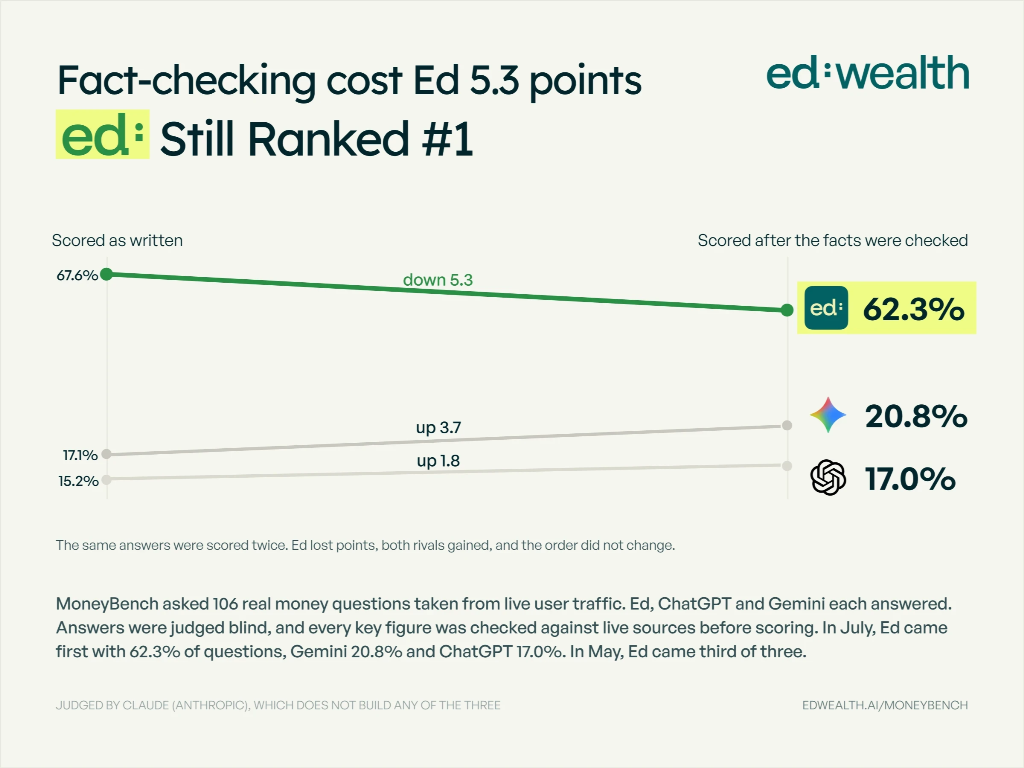
The July round ran 106 real production questions. A Claude model from Anthropic, which builds none of the three systems, verified every answer’s key facts against live sources as of 23 July 2026. That fact-check cut the leader’s own score by 5.3 points while lifting the others, and the ranking held. One answer was thrown out under an accuracy veto for stating a false fact. A confident wrong number should lose outright.
I’ll give EdWealth credit for the part most vendors bury. It publishes the rounds it lost (Ed finished dead last in the May round, before it was rebuilt), and it says in plain language that the figures cannot be independently verified, and that you should weigh the method rather than take the score on faith.
The short version
You don’t have to settle whether AI is trustworthy in the abstract. You only have to judge the answer in front of you, and now you can. Did it fetch live numbers, commit to a view, keep facts apart from opinion, reflect your situation, and show its sources? Run any money answer through those and the weak ones fall away fast.
Used with a little skepticism, these tools make a good thinking partner for money questions. Ed is built around the same behaviors: education rather than advice, your accounts read-only, the reasoning shown, and no buy or sell calls. If you want to see how the systems were scored, read the full MoneyBench results.

Alexia is the author at Research Snipers covering all technology news including Google, Apple, Android, Xiaomi, Huawei, Samsung News, and More.