Why the Most Efficient Facilities Usually Aren’t the Ones Using the Least Energy
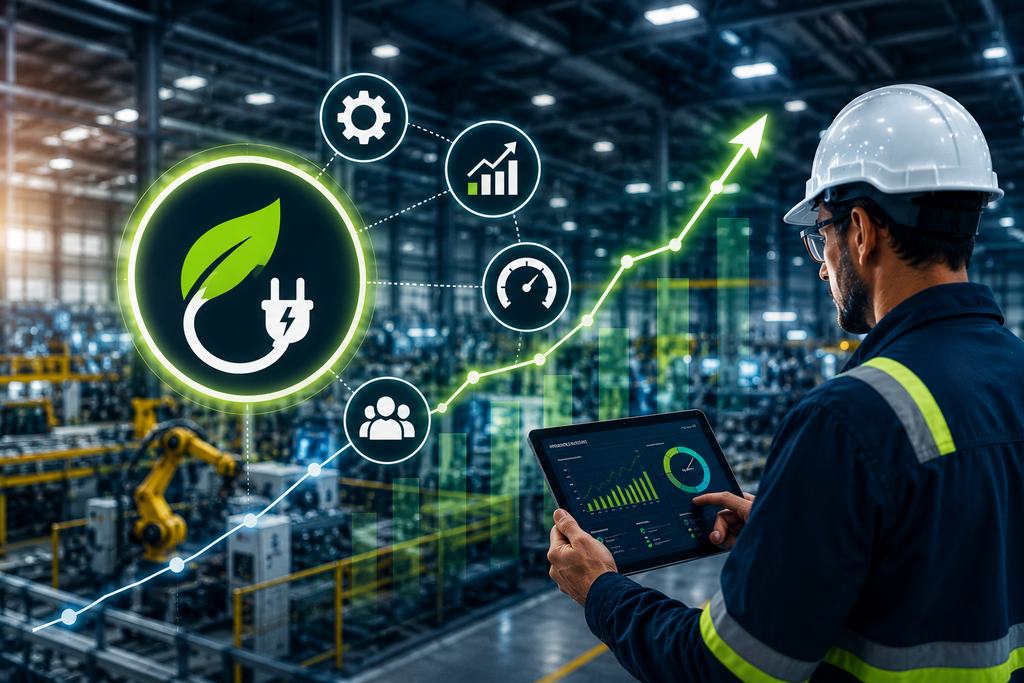
When executives talk about improving efficiency, the conversation usually turns to familiar topics. Production output, labour utilization, inventory management, automation, and supply chain performance are all measured closely because they have a direct influence on profitability. Energy is certainly part of those discussions, but it is often viewed primarily as an operating expense rather than a measure of how efficiently an organization functions.
That perspective is beginning to change
Across North America, industrial companies are taking a broader view of energy performance. Rather than focusing exclusively on reducing electricity consumption, many organizations are asking a different question altogether. They want to understand whether every unit of energy consumed is creating as much business value as possible.
It is an important distinction because using less electricity does not automatically mean an operation has become more efficient.
Consider two manufacturing facilities producing identical products. One consumes less electricity, but regularly experiences equipment failures, inconsistent production schedules, and lower throughput. The other consumes slightly more electricity while maintaining higher production volumes, better product quality, and significantly less downtime. Looking only at the monthly utility bill would suggest the first facility is performing better, yet almost every operational indicator points in the opposite direction.
That example illustrates why many organizations have moved beyond thinking about energy simply as a cost.
Electricity is now being evaluated alongside productivity, equipment reliability, maintenance performance, and overall operational effectiveness. The objective is not to reduce consumption at all costs. It is to understand whether energy is being used in the most productive way possible.
Modern industrial facilities are making that evaluation easier than ever before.
Production equipment continuously reports operating conditions. Building automation systems adjust heating and cooling based on occupancy and environmental conditions. Intelligent electrical infrastructure monitors equipment loading, while maintenance platforms record the performance history of thousands of assets across an entire facility.
Taken individually, each system provides valuable information
Combined, they offer something much more powerful. They provide a detailed understanding of how electricity supports every stage of the operation.
This integrated view often reveals opportunities that traditional energy reporting never could.
A production line may consume more electricity than expected because equipment is operating outside its optimal range. Building systems may continue conditioning unoccupied areas long after production has ended. Motors, pumps, and compressors may gradually lose efficiency without creating obvious maintenance concerns. None of these issues necessarily increase electricity costs dramatically on their own, but together they can influence productivity, maintenance budgets, equipment life, and long-term operating performance.
One of the more interesting developments is that many organizations are discovering their greatest efficiency improvements have very little to do with electricity itself.
Instead, energy data often highlights broader operational opportunities.
For example, production scheduling may be adjusted to reduce unnecessary equipment cycling. Maintenance teams may identify mechanical issues before they develop into failures. Engineering departments can compare identical production lines operating under different conditions to understand why one consistently performs better than another. Facility managers gain greater visibility into building systems that quietly consume energy without contributing meaningful value to the business.
The conversation therefore becomes much broader than simply reducing kilowatt-hours.
It becomes a discussion about how efficiently the entire organization operates.
That is one reason executive leadership teams have become more involved in energy discussions than they were in previous decades. They recognize that operational efficiency, capital investment, equipment reliability, and energy performance are becoming increasingly interconnected. Decisions made in one area often influence outcomes in another, making a broader understanding of facility operations increasingly valuable.
Technology has accelerated this transition, but the underlying objective remains remarkably practical.
Businesses want better information so they can make better decisions
That distinction becomes even more important as facilities continue investing in automation and digital technologies. Modern manufacturing plants, distribution centres, food processing facilities, pharmaceutical operations, and commercial buildings rely on thousands of interconnected assets working together throughout the day. Electricity powers each of those systems, but simply reducing consumption is rarely the objective. The real goal is ensuring every kilowatt-hour contributes as much value as possible to the operation.
This is where many organizations discover the difference between energy reduction and energy optimization.
Reducing energy consumption is relatively straightforward. Equipment can be shut down, production schedules shortened, lighting reduced, or building temperatures adjusted. Those changes may lower electricity costs, but they can also reduce productivity, increase maintenance requirements, or negatively affect product quality if implemented without understanding the broader operation.
Optimization requires a different mindset
Instead of asking where electricity can be eliminated, organizations begin asking whether electricity is being used in the right places, at the right time, and in the most effective way. That question often leads to opportunities that improve both operational performance and energy efficiency simultaneously.
For example, a manufacturing facility may discover that one production line consistently consumes more electricity than another producing identical output. Rather than assuming the equipment simply requires more power, engineers may investigate operating conditions and discover that maintenance practices differ between the two lines. A worn bearing, improperly aligned conveyor, or partially obstructed ventilation system may gradually increase electrical demand while remaining unnoticed during routine production.
Addressing the underlying issue improves equipment reliability, extends asset life, reduces maintenance costs, and lowers electricity consumption at the same time.
The same principle applies across many industries.
Commercial office buildings frequently discover heating and cooling systems operating long after occupants have left for the day because schedules no longer reflect how spaces are actually being used. Warehouses identify battery charging practices that increase demand unnecessarily during peak operating periods. Hospitals evaluate ventilation systems to ensure environmental requirements are met without consuming more energy than necessary. Universities compare similar buildings across campus and often find significant differences in electrical performance despite nearly identical occupancy levels.
These examples illustrate an important point
Energy efficiency is often the outcome of better operational management rather than the result of isolated energy projects.
Artificial intelligence is beginning to strengthen this approach by helping organizations identify patterns that would otherwise remain difficult to recognize. Modern industrial facilities generate enormous volumes of operational information through connected equipment, automation systems, environmental controls, electrical infrastructure, and maintenance platforms. Reviewing all of that information manually is simply not practical.
Advanced analytics help engineering teams identify relationships that develop gradually over time.
A small increase in electrical demand may coincide with seasonal production changes. Equipment operating temperatures may begin rising months before maintenance issues become visible. Building systems may consume additional electricity because occupancy patterns have changed while control strategies have remained the same. Individually, these observations appear insignificant. Viewed together, they often reveal opportunities for meaningful operational improvement.
Perhaps the biggest change taking place is that energy information is no longer confined to engineering departments.
Finance teams increasingly examine operational efficiency when evaluating capital investments. Operations managers review electrical performance alongside production metrics to better understand equipment utilization. Sustainability teams use operational data to measure progress toward environmental objectives, while executive leadership considers energy performance as part of broader discussions involving business continuity, competitiveness, and long-term growth.
Energy has become another business metric
It sits alongside productivity, maintenance performance, quality, labour utilization, and financial reporting because each influences the others. Organizations that understand those relationships are generally better positioned to improve operational performance than those evaluating each function independently.
This integrated approach also changes how businesses think about investment.
Rather than replacing equipment simply because it has reached a certain age, organizations increasingly evaluate whether assets continue delivering acceptable operational performance. Modern monitoring technologies allow engineering teams to understand how equipment behaves under actual operating conditions, supporting more informed decisions regarding upgrades, modernization, and long-term capital planning.
For many organizations, implementing these strategies requires expertise that combines engineering knowledge with operational analysis and practical business experience.
Working with an experienced energy services company gives businesses access to specialists who understand both the technical and operational sides of industrial energy. Rather than focusing solely on reducing electricity consumption, these organizations evaluate how energy influences production, maintenance, facility operations, and long-term business performance. That broader perspective helps companies identify improvements that strengthen reliability, support sustainability objectives, and improve productivity while making better use of existing infrastructure.
Looking ahead, the conversation surrounding industrial energy will almost certainly continue evolving.
Electricity demand will grow as transportation becomes increasingly electrified, artificial intelligence expands digital infrastructure, and manufacturers continue investing in automation. At the same time, businesses will face ongoing pressure to improve productivity while controlling operating costs and meeting higher expectations for environmental performance.
Those objectives are not mutually exclusive
In many cases, organizations that operate most efficiently are also those that understand their energy use most thoroughly. They recognize that electricity is not simply another utility expense but one of the resources that enables every aspect of modern operations. Better visibility into how energy supports production leads to better maintenance decisions, stronger capital planning, improved operational resilience, and greater long-term competitiveness.
Perhaps that is why the definition of efficiency is beginning to change.
The most efficient facilities are rarely the ones using the least electricity. More often, they are the organizations extracting the greatest value from every unit of energy they consume. They understand how electricity supports their operations, continuously measure performance, and use reliable operational information to guide investment and improvement. In an increasingly competitive industrial economy, that ability to connect energy with business performance may prove to be one of the most valuable advantages an organization can develop.

Alexia is the author at Research Snipers covering all technology news including Google, Apple, Android, Xiaomi, Huawei, Samsung News, and More.