Low Latency AI Inference: Here’s Our Top Picks

A voice agent that pauses before answering feels broken, even when its answer is right.
The same goes for a coding assistant that stalls mid-suggestion or an agent that crawls through a ten-step task.
That delay comes from inference, the step where a trained model turns a prompt into output. The faster a platform returns that output, the more natural your product feels to the people using it.
Below, we explain what low latency inference means, what slows it down and how to speed it up. Then we review four platforms built for fast responses: Telnyx, Groq, Cerebras and Fireworks AI.
- Telnyx: Good fit if you want inference on the same network and API key as its voice AI.
- Groq: Good fit if you want an OpenAI-compatible API with service tiers you can pick per request.
- Cerebras: Good fit if you want to run more reasoning without going over your latency budget.
- Fireworks AI: Good fit if you want fast serving for open models you have post-trained yourself.
What Is Low Latency AI Inference?
Low latency AI inference means getting a model’s output back with as little delay as possible. It matters most when someone is waiting on the other end, as in voice agents, chat, coding assistants and multi-step agents.
The delay a user feels has three parts:
- Time to first token, which covers queueing and processing the prompt.
- Decoding time, the time the model spends generating all of the output tokens.
- The network round trip between your app and the server.
Several things push these numbers up:
- Longer prompts raise the time to first token.
- Longer replies add decoding time, because the model generates one token after another.
- Larger models tend to generate more slowly than smaller ones.
- Reasoning models add extra processing before they answer.
You can cut delay in a few ways:
- Pick a smaller model when it handles the task well, and keep prompts and replies short.
- Stream output so users see the reply as it forms.
- Run inference in a region close to your users to shorten the network trip.
Hardware plays a big part too.
Some providers run models on general GPUs, while others build their own chips designed for fast token generation.
Some platforms also offer service tiers, so you can send interactive traffic to faster capacity and background jobs to capacity tuned for volume.
Top Picks for Low Latency AI Inference At a Glance
| Telnyx | Groq | Cerebras | Fireworks AI | |
| Hardware | Owned GPUs co-located with its network | LPU-based infrastructure | Wafer-Scale Engine | GPUs running a disaggregated engine |
| Latency Feature | Priority tier for interactive workloads | On-demand tier with streaming | Up to 30x faster inference than GPU systems | Split prefill and decode pools that cut latency |
| Deployment | Serverless, in-region across four regions | Cloud API or dedicated bare metal | Cloud API or dedicated inference | Serverless, on-demand or reserved capacity |
1. Telnyx
Telnyx delivers low latency AI inference by running a curated set of open-weight models on GPUs it owns, placed alongside the network your users connect through. The same infrastructure and API key also cover its telephony, text-to-speech and voice AI products.
How Telnyx Inference Works: Inference runs in-region in the Americas, Europe, MENA or APAC, with no hops between providers and no routing across borders. Telnyx says that on select models, a Priority tier moves interactive work such as voice orchestration onto faster serving capacity, and turning it on takes a single request field. Capacity scales on its own as load climbs into the thousands of requests each second, and there are no cold starts.
Why Choose Telnyx: Because the API is OpenAI-compatible, switching only means pointing your current SDK at a new base URL. Chat completions run with zero data retention, so request and response content isn’t stored after the call.
2. Groq
Groq runs its platform on LPU chips and operates 13 data centers on four continents. Its API is OpenAI-compatible, so you can point the OpenAI client libraries at Groq’s base URL.
How Groq Works: Groq says its on-demand tier is built for real-time apps and supports streaming, so replies start showing right away. A Flex tier trades occasional failures for higher request volumes, and an Auto tier falls back to Flex when you pass your on-demand rate limits. The Groq Console request logs show time to first token, total server time and tokens per second for each request.
Why Choose Groq: Teams that need more control can move up to GroqMetal, dedicated bare-metal infrastructure, with GroqCore adding a tested inference stack on top. GroqAssured layers enterprise governance and auditability over both.
3. Cerebras

Cerebras runs inference on its Wafer-Scale Engine, a chip 58x larger than GPUs. Its inference cloud is built for fast, interactive products in coding, research, voice, automation and agentic use cases.
How Cerebras Works: You call models through an API with OpenAI compatibility, which takes two code changes to set up. For production, Dedicated Inference gives you private, reserved capacity with stable endpoints and predictable throughput.
Why Choose Cerebras: According to Cerebras, faster inference lets you run more reasoning within the same latency budget, which can raise output quality. Enterprise customers can also get uptime guarantees, dedicated queue priority and custom model weights.
4. Fireworks AI
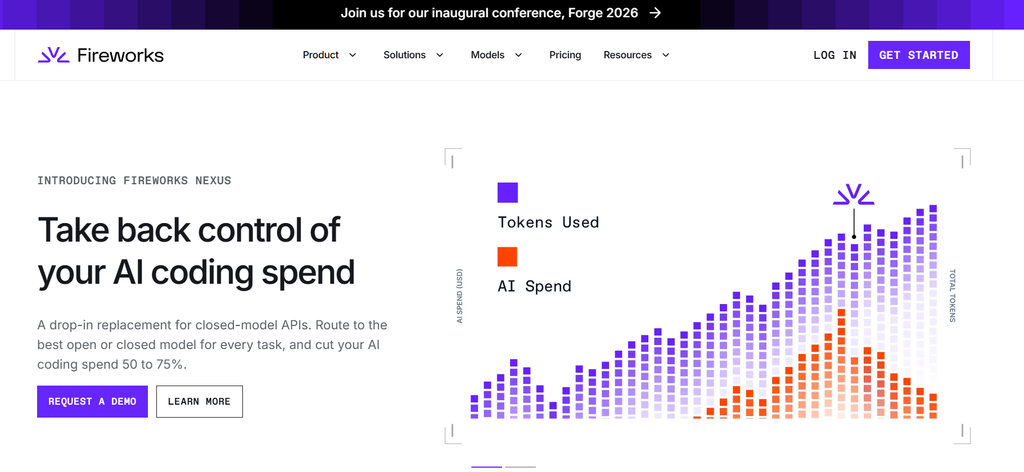
Fireworks AI serves frontier open models and your own post-trained versions of them, using an engine tuned at every layer for production. You can call a model per request, deploy it on dedicated on-demand hardware or reserve guaranteed capacity.
How Fireworks AI Works: Fireworks AI says prefill and decode run on two GPU pools that scale apart from each other, which lowers latency and keeps GPUs in use. Lengthy prompts and multi-turn chats stay quick thanks to disaggregated KV caching and routing that takes the prompt into account. The engine also uses custom kernels, quantization and speculative decoding.
Why Choose Fireworks AI: New open models get day-zero support with model-specific optimizations, so you don’t wait months for fast serving. The serverless API works with OpenAI and Anthropic formats, so you can migrate by swapping a URL.
Conclusion
Low latency inference shapes how fast your product feels.
Start by measuring where your delay comes from, then trim prompts, stream output, pick right-sized models and run close to your users.
The right platform depends on your workload, your models and where your users are.
So, you might consider testing a few with your real traffic, comparing time to first token and total response time, and choosing the one that keeps your users from waiting.

Alexia is the author at Research Snipers covering all technology news including Google, Apple, Android, Xiaomi, Huawei, Samsung News, and More.