Why Companies Are Quietly Returning to In-Person Interviewing
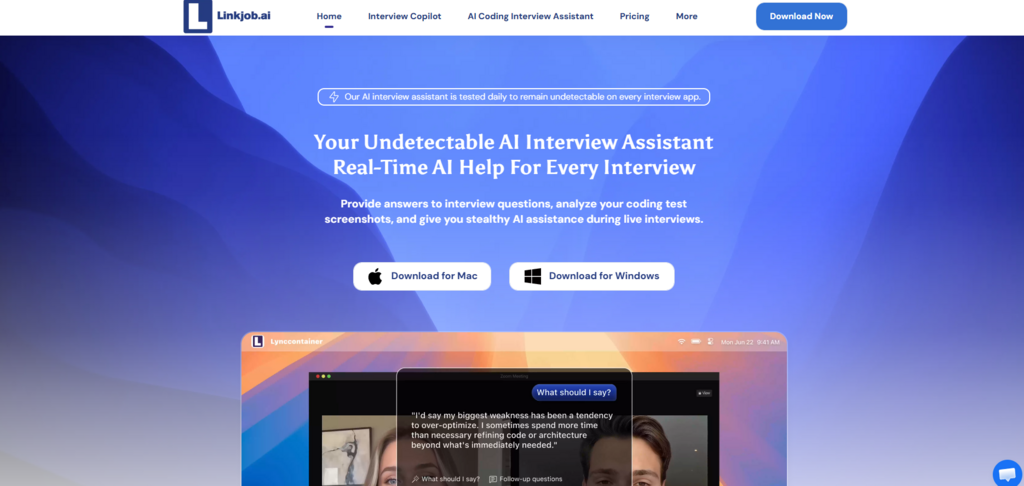
Something unexpected happened in the first quarter of 2026. After years of celebrating remote hiring as the permanent future of talent acquisition, several major technology employers began quietly reintroducing mandatory in-person interview rounds. The shift was not announced in splashy blog posts or CEO manifestos. It appeared in the fine print of interview scheduling emails, in recruiter phone calls that mentioned a final onsite, and in the slow disappearance of fully remote interview loops that had become standard during the pandemic era. The reason, according to multiple hiring platform analyses published this year, is straightforward: remote interview integrity has become unenforceable at scale. An AI interview assistant that operates invisibly during live video calls is no longer a hypothetical threat. It is a widely available commercial product, and employers have noticed.
What the Numbers Actually Say About Remote Interview Integrity
The data that forced this reckoning did not come from any single company. It accumulated across platforms, industries, and geographies until it became impossible to ignore. CodeSignal, which analyzed millions of proctored technical assessments, reported that cheating and fraud attempt rates more than doubled in 2025, rising from 16% in 2024 to 35%. The surge was sharpest in the second half of the year, suggesting a compounding effect as tools improved and awareness spread. A separate analysis by Fabric, an AI interview platform, examined over 19,000 AI-led interviews conducted between mid-2025 and early 2026. Their findings were starker: nearly 39% of all candidates triggered cheating behavior markers, with the rate among technical candidates climbing to 48%. Perhaps most tellingly, 61% of flagged candidates had already exceeded the passing score threshold, meaning that without additional detection layers, those candidates would have advanced.
The Gap Between Proctored and Unproctored Assessment Outcomes
Xobin, a recruitment assessment platform that validated its AI Trust Score across 442,000 candidates from 171 countries, published findings that explain why the distinction between proctored and unproctored assessments matters. According to independent HR research cited in their analysis, the candidate cheating rate on unproctored online tests is roughly three times higher than on proctored ones. Yet despite this, more than 40% of companies running remote hiring still use little to no active proctoring, often citing concerns about candidate experience. The result is a bifurcated hiring landscape where well-resourced employers deploy increasingly sophisticated detection while smaller organizations remain effectively blind to the problem.
How Employers Are Responding With Structural Changes
The response from large employers has been pragmatic rather than punitive. A handful of prominent venture-backed startups have publicly acknowledged discovering that more than half of their candidates used AI assistance during recruitment rounds, prompting a full return to in-person evaluations. Discussions among hiring platform executives have centered on reintroducing at least one face-to-face interview round specifically to verify that a candidate can perform without AI augmentation. From a practical perspective, the logic is simple: an invisible desktop overlay that works flawlessly during a remote screen share becomes irrelevant when the candidate is sitting in a conference room with a whiteboard.
The Three-Step Workflow That Made Invisible Assistance Possible
Understanding why employers are worried requires understanding what the technology actually does. Based on the platform documentation for one widely cited tool, the workflow that enables invisible real-time assistance follows three distinct stages.
Step 1: Configure a Personalized Interview Profile
Before any interview, the user defines the context that shapes all subsequent AI suggestions.
Uploading a Resume and Defining the Target Stack
The user uploads a resume, specifies the target role and industry, and selects preferred programming languages. The platform also accepts free-text notes containing personal talking points, specific frameworks, or anecdotes that the user wants the AI to reference. In my testing, this configuration step made the difference between generic, template-like suggestions and answers that felt anchored to actual experience. The AI does not fabricate a background. It rearranges provided material into formats that interview evaluators expect.
Step 2: Activate the Desktop Overlay
Once the interview begins, the user enables the assistant and the entire visual interface disappears from common system indicators.
How OS-Level Rendering Bypasses Screen Capture
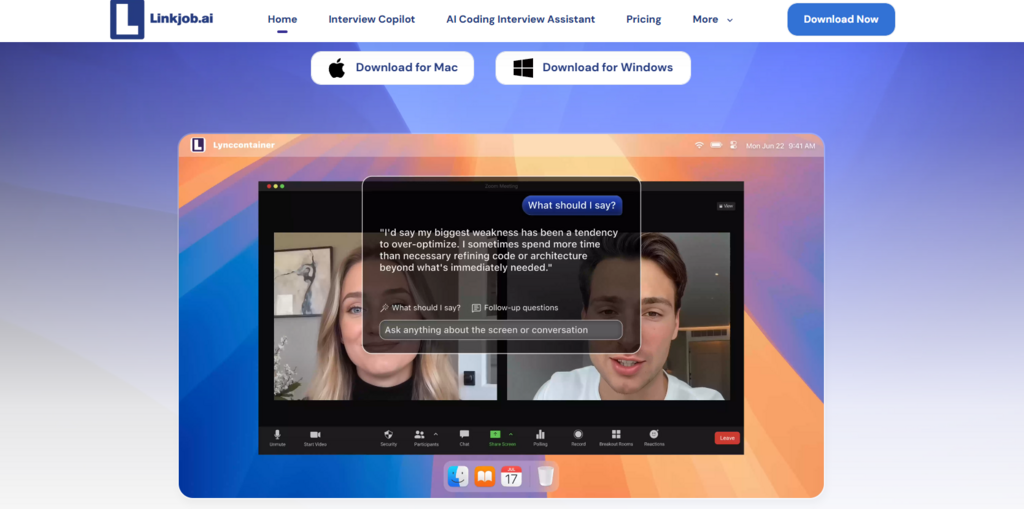
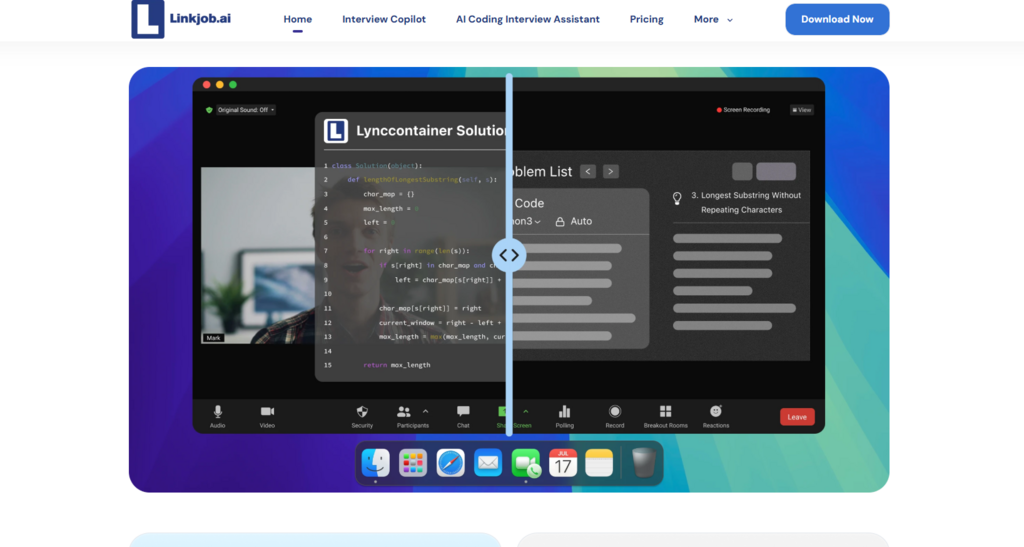
AI interview tool uses operating system window properties that exclude its interface from screen captures, screen recordings, and live screen sharing. The same approach is used by password managers and privacy applications, but applied here to interview contexts. In testing across Zoom, Google Meet, and Microsoft Teams, the overlay remained visible only to the user. Screen recordings captured the shared coding window or slide deck but never the AI suggestion panel.
Step 3: Receive Real-Time Suggestions During the Call
With the overlay active, the AI continuously processes interviewer speech and shared screen content.
From Audio Transcription to Structured Answer Generation
The tool transcribes spoken questions, analyzes shared coding problems via screenshot capture, and generates structured answers in what the platform describes as under a quarter of a second. For behavioral questions, suggestions follow the STAR method. For technical problems, the output includes working code with complexity notes. For system design prompts, the tool generates talking points organized by architectural layer. The speed makes the interaction feel closer to recalling a prepared note than waiting for an external search.
How the Hiring Infrastructure Is Adapting to the New Reality
The detection industry has responded with a wave of innovation that mirrors the sophistication of the tools it targets. Talview secured a U.S. patent for an agentic AI proctoring system named Alvy, which applies a seven-layer security framework designed to detect not just known cheating tools like Cluely, FinalRound AI, and Virtual Machine but also the behavioral patterns that indicate AI-assisted answering. The system claims to identify eight times more suspicious activity than traditional passive monitoring, with deepfake detection accuracy at 95%. Xobin has pursued a different approach with its AI Trust Score, which measures cross-signal consistency across typing patterns, response timing, eye movement, audio analysis, and browser behavior to produce a bimodal distribution that cleanly separates compliant candidates from high-risk ones. Rather than flagging individual actions, these systems look for the signature of AI assistance: perfectly structured answers produced with minimal pauses, gaps between written output quality and verbal explanation depth, and the subtle timing irregularities that occur when a candidate reads from an invisible teleprompter.
Comparing Employer Strategies for Interview Integrity
Different organizations have adopted fundamentally different philosophies for addressing the problem.
| Strategy | Method | Effective Against | Limitations | Candidate Experience |
| Device Management | Blocking unauthorized software via corporate MDM | All desktop-based AI tools on managed devices | Cannot control personal devices | High friction on work devices |
| Behavioral Scoring | Cross-signal analysis of response patterns | Invisible overlays and off-screen helpers | Requires substantial data for calibration | Low visibility to candidate |
| In-Person Verification | Mandatory onsite interview round | All remote cheating methods | Logistically costly; limits candidate pool | Mixed; removes convenience |
| Traditional Proctoring | Browser lockdown and webcam monitoring | Basic tab switching and obvious second screens | Misses desktop overlays entirely | Often described as invasive |
What the Return to In-Person Means for Different Stakeholders
The shift back toward physical interview rounds creates winners and losers. For employers in competitive talent markets, the trade-off is between assessment accuracy and candidate pool breadth. Requiring an onsite visit eliminates remote candidates who might otherwise have been viable, particularly those in different time zones or with caregiving responsibilities. For candidates who have invested in AI tools as interview preparation aids rather than real-time crutches, the impact is minimal because their underlying skills remain intact. The group most affected is candidates who relied on invisible assistance to bridge a genuine skills gap. When the whiteboard replaces the shared screen, no overlay can help.
A more subtle consequence is the erosion of trust that now colors the entire hiring process. When hiring managers suspect that impressive remote performances may be AI-generated, candidates who genuinely excel in remote settings lose the benefit of the doubt. The suspicion becomes ambient, unstated, and corrosive. This dynamic may ultimately prove more damaging to remote hiring than any individual cheating incident.
For job seekers navigating this transition, the practical implications are clear. Preparing for in-person technical assessments, whiteboard coding, live problem-solving, and unrehearsed behavioral probing, will become essential even for roles advertised as remote-first. The companies that have not yet reintroduced in-person rounds may simply be waiting for the right moment. The AI interview tool that works invisibly during a video call has already changed the hiring landscape, not by winning the arms race, but by forcing a retreat to formats where no tool can follow.

Alexia is the author at Research Snipers covering all technology news including Google, Apple, Android, Xiaomi, Huawei, Samsung News, and More.