AI Is Redefining Electricity Forecasting as Power Systems Become Increasingly Digital
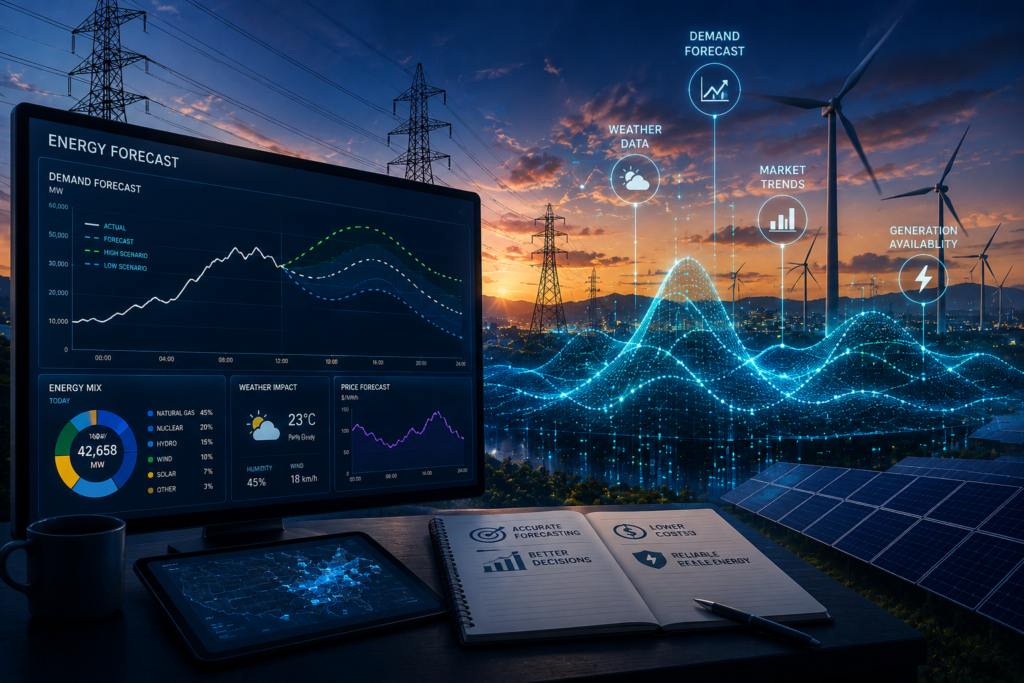
Artificial intelligence is rapidly changing how critical infrastructure is managed around the world. While much of the public conversation has focused on generative AI, autonomous assistants, and large language models, one of the most significant transformations is taking place behind the scenes inside electricity systems. Grid operators, utilities, large industrial organizations, and energy analysts are increasingly turning to machine learning to solve problems that traditional forecasting methods struggle to address.
Electricity systems have always depended on forecasting. Operators must estimate how much electricity consumers will require hours, days, months, and even years into the future while ensuring sufficient generation and transmission capacity remains available to maintain system reliability. Historically, these forecasts relied on statistical models built around historical demand, seasonal trends, weather forecasts, calendar effects, and economic indicators. Those techniques served the industry well for decades because the variables influencing electricity consumption changed relatively slowly.
Today’s electrical grid operates under very different conditions.
Renewable generation has introduced variable supply that changes with cloud cover, wind speeds, and weather systems. Electric vehicles continue increasing demand while altering traditional consumption profiles. Battery storage systems can both consume and supply electricity throughout the day. Distributed energy resources allow businesses to generate electricity onsite, reducing grid demand at certain times while exporting excess generation during others. Artificial intelligence itself is contributing to rising electricity consumption through the rapid expansion of hyperscale computing facilities that require continuous access to reliable power.
The result is an operating environment where forecasting has become significantly more complex.
Rather than predicting a relatively stable demand curve, analysts now evaluate thousands of interacting variables that continuously influence electricity systems. Weather conditions remain important, but they represent only one component within a much larger analytical framework. Grid conditions, equipment availability, renewable generation output, industrial production schedules, electricity pricing, transmission constraints, consumer behaviour, and distributed energy resources all contribute to constantly evolving operating conditions.
Traditional forecasting methods often struggle when relationships between variables change rapidly.
Machine learning models approach these challenges differently. Instead of relying primarily on predefined mathematical relationships, they continuously learn from historical observations while incorporating new information as conditions evolve. This allows forecasting models to identify patterns that would be difficult or impossible to recognize using conventional statistical techniques alone.
For example, a machine learning platform can evaluate how humidity, cloud movement, industrial operating schedules, school holidays, electric vehicle charging behaviour, and historical transmission congestion interact simultaneously to influence future electricity demand. As additional data becomes available, forecasting accuracy continues improving without requiring analysts to manually redesign every model.
This adaptive capability is becoming increasingly valuable as electricity systems experience more frequent periods of volatility.
Extreme weather events illustrate this particularly well. Heat waves, winter storms, hurricanes, and prolonged droughts all influence electricity demand while simultaneously affecting generation resources and transmission infrastructure. Artificial intelligence allows forecasting systems to evaluate these interconnected risks more dynamically, enabling operators to prepare for changing conditions earlier than traditional forecasting approaches often permit.
Artificial intelligence is also changing the way operational decisions are made after forecasts have been produced.
Instead of generating static reports for human review, modern analytical platforms increasingly support continuous decision-making by monitoring live operational data and identifying emerging trends in real time. Grid operators can receive early warning indicators for potential reliability concerns. Large industrial facilities can evaluate operational adjustments before electricity costs increase. Utilities can identify infrastructure assets requiring maintenance before failures occur. These capabilities shift organizations from reactive operations toward predictive management.
The rapid deployment of Internet of Things sensors has accelerated this transition.
Modern substations, transformers, industrial equipment, renewable energy facilities, battery storage systems, and commercial buildings generate enormous quantities of operational data every second. Smart meters alone produce far more information than traditional monthly utility billing ever provided. Combined with satellite weather observations, transmission monitoring systems, geographic information systems, and operational control platforms, electricity organizations now possess access to data volumes that would have been unimaginable only a decade ago.
Collecting information, however, represents only part of the challenge.
Without sophisticated analytical capabilities, organizations risk becoming overwhelmed by the sheer quantity of available data. Artificial intelligence enables these datasets to be organized, interpreted, and transformed into actionable operational intelligence. Rather than reviewing thousands of individual measurements, analysts receive prioritized insights that support planning, infrastructure investment, operational reliability, and strategic decision-making.
Digital twin technology is becoming another important application of artificial intelligence within electricity systems. These virtual models replicate physical infrastructure using continuously updated operational information. Utilities and industrial organizations can simulate equipment performance, evaluate future operating scenarios, assess infrastructure investments, and estimate the impacts of changing electricity demand without introducing risk into live operating environments.
As these digital representations become more sophisticated, they enable planners to test multiple scenarios before implementing changes across physical infrastructure, reducing uncertainty while improving long-term planning accuracy.
The emergence of large language models is further expanding the role of artificial intelligence within the energy sector. While these technologies are widely recognized for generating text and assisting with knowledge work, their value within electricity operations extends much further. Modern AI systems are beginning to summarize operational events, interpret regulatory documentation, identify anomalies across thousands of data points, and support analysts by rapidly synthesizing information that would previously have required hours of manual review.
Rather than replacing experienced engineers or system operators, these technologies allow technical specialists to spend more time evaluating strategic issues and less time assembling information from multiple disconnected systems. Human expertise remains central to operational decision making, but AI increasingly serves as a force multiplier by accelerating analysis and improving situational awareness.
This evolution also highlights an important reality that extends well beyond the energy industry. Artificial intelligence is only as effective as the information on which it is trained. Inaccurate, incomplete, or poorly structured data can reduce forecasting accuracy regardless of how sophisticated the underlying algorithm may be. As organizations continue investing in predictive analytics, the quality, consistency, and transparency of operational data have become strategic priorities in their own right.
Electricity markets provide a valuable example of this principle. Every day, system operators publish extensive operational information covering demand, generation, transmission conditions, market activity, and system performance. These datasets support researchers, software developers, utilities, consultants, industrial organizations, and technology companies seeking to improve forecasting methodologies or evaluate changing market behaviour.
Among the resources available to analysts, IESO market data demonstrates how transparent operational information can support more sophisticated energy analytics. The value lies not in a single dataset itself, but in the broader principle that accessible, reliable information enables better forecasting models, stronger analytical validation, and more informed decision making. As artificial intelligence becomes increasingly embedded within electricity operations, trusted data sources will continue serving as the foundation upon which predictive systems are built.
Another area experiencing rapid innovation is autonomous optimization. Rather than simply forecasting future conditions, next-generation analytical platforms are beginning to recommend operational actions based on continuously changing system conditions. A manufacturing facility may receive recommendations to shift non-critical production to periods of lower system demand. Commercial buildings can automatically optimize heating, ventilation, and cooling systems while maintaining occupant comfort. Battery storage assets can respond dynamically to changing operating conditions without requiring constant manual intervention.
Although fully autonomous electricity management remains an emerging capability, the trajectory is becoming increasingly clear. Artificial intelligence is evolving from a decision-support tool into an operational partner capable of continuously evaluating thousands of variables and identifying opportunities that would otherwise remain hidden within complex datasets.
The accelerating growth of electrification will further increase the importance of these technologies. Electric transportation, advanced manufacturing, digital infrastructure, and artificial intelligence itself are all contributing to higher electricity demand across developed economies. At the same time, utilities continue integrating larger volumes of renewable generation while modernizing aging infrastructure. Successfully balancing these competing priorities will require analytical capabilities that extend beyond conventional planning methods.
Forecasting therefore becomes more than an operational exercise. It becomes a strategic capability that influences infrastructure investment, business continuity, sustainability initiatives, and long-term economic competitiveness. Organizations able to combine advanced artificial intelligence with high-quality operational data will be better positioned to anticipate changing conditions instead of reacting after they occur.
The next generation of electricity systems will not simply generate more data than previous generations. They will depend on the ability to transform that information into timely, reliable intelligence. As digital technologies continue reshaping critical infrastructure, the organizations that lead in predictive analytics, data governance, and AI-enabled decision making will help define how resilient, efficient, and adaptive tomorrow’s energy systems become.

Alexia is the author at Research Snipers covering all technology news including Google, Apple, Android, Xiaomi, Huawei, Samsung News, and More.