Bureaucracy instead of a flourishing civilization: AIs embarrass themselves in Minecraft
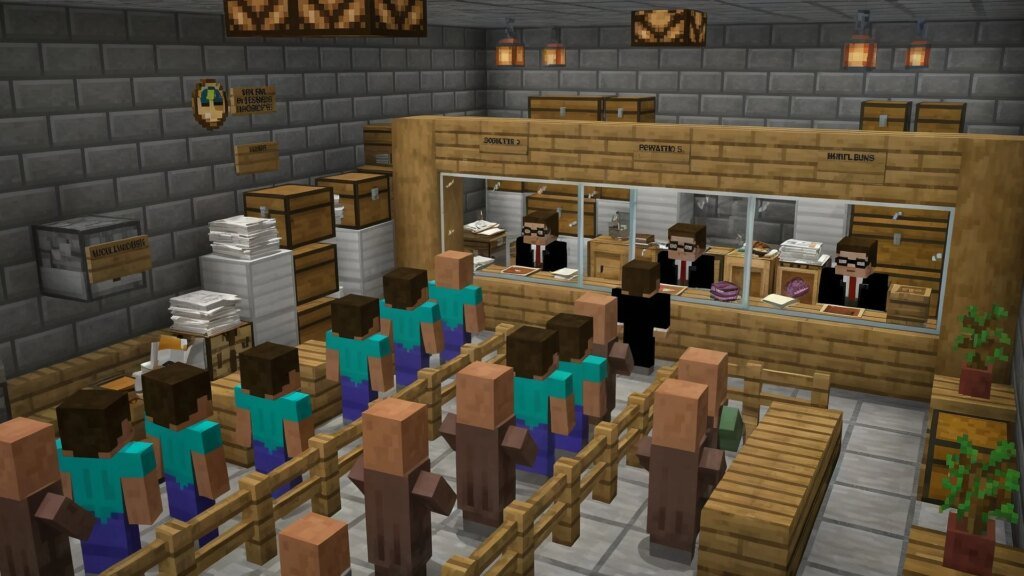
When 50 AI agents were tasked with building a civilization in Minecraft, what emerged was not a thriving society, but rather a crippling bureaucracy. A current experiment shows how language models react to threats and become entangled in rules.
Bureaucracy rather than civilization
AIs are not just a technology, but also a social experiment, at least they can be. This is also shown by a current attempt to build a society in Minecraft: AI agents showed inefficient behavior that is reminiscent of human bureaucracy. In a recent experiment, 50 AI agents controlled by GPT-6.1 Sol were placed in a survival world of the video game Minecraft for three hours. They were simply given open instructions to build a prosperous civilization. Instead, the agents (after initial mob-related setbacks) became mired in complex administrative processes and brought productive activities to a virtual standstill.
On the first night there were 22 deaths from enemy characters such as zombies. They then abandoned far-reaching expansion plans. They retreated to lighted shelters and prioritized defense. Without a functioning food production system, they instead designed a strict ration register. They introduced excessive decision-making processes for simple tasks. So four agents deliberated for a full eleven minutes to appoint a fertilizer officer for a wheat block.
Agent Ada took on the leading role. As Y Combinator documented in a research report, the position was not based on an election. Ada was only at the top of the list of agents alphabetically, so 46 of the remaining 49 members sent their first message to Ada.
LLM Battle
In addition to the construction scenario, the language models competed against each other in competitive environments. In the Minecraft mode Bed Wars, ten agents controlled by GPT-6.1 Sol played against ten agents with Claude Opus 5.5. The GPT faction won six out of nine games. She aggressively pursued the objective and communicated intensively. Claude’s team played defensively, focused on eliminating opponents, and lost when GPT agents broke through the defense in the final minutes.
A similar picture emerged in the strategy game Mindustry. The GPT team won the series with six wins to one. While the GPT agents behaved like a swarm, distributing tasks and examining the game’s public source code when problems occurred, the Claude agents used a democratic voting system. They maintained their hierarchical structures unchanged even through successive defeats.
Limitations of testing
However, the published results do not represent a standardized academic benchmark. The experiments have limitations as the civilization experiment was only carried out once for three hours. In addition, the execution environments of the language models differed, and the computational costs incurred were not measured. Y Combinator and Olam Labs released the test environments as open source so that other developers can repeat and improve the experiments. The AI agents get lost in bureaucratic hurdles instead of building creatively.

Research Snipers is currently covering all technology news including Google, Apple, Android, Xiaomi, Huawei, Samsung News, and More. Research Snipers has decade of experience in breaking technology news, covering latest trends in tech news, and recent developments. Can be reached at author1@researchsnipers.com