Digital insect: Software developers let fruit fly play Doom

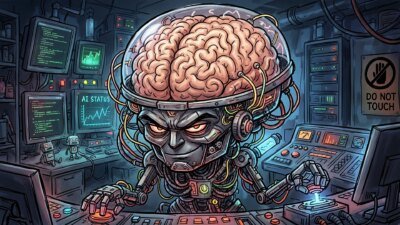
Researchers have completely mapped and digitized the brain of a fruit fly. Developers are now using the huge neural network for a bizarre experiment. They teach the virtual insect to play video games like Doom.
Fly brain fully mapped
Recently, researchers from Google and the Janelia Research Campus published the results of a ten-year study project published: They have mapped the entire brain and central nervous system of a male fruit fly. The model, called the connectome, includes over 166,000 neurons and 125 million synaptic connections. The scientists’ goal is to deepen our understanding of neuronal reactions and stimulus processing.
To do this, they cut the fly’s nervous system into over 7,000 tiny slices, scanned the material with high-resolution electron microscopes and then used artificial intelligence for the detailed three-dimensional reconstruction. It is of course no coincidence that the choice fell on this annoying animal in the kitchen. Since the human brain with its 86 billion neurons is currently far too complex to be fully understood, small insects serve as an ideal model organism for researchers.
Fly controls video games
As Gizmodo reported, external software developers immediately took advantage of the scientists’ data set, which was freely accessible worldwide – with certainly expected consequences. They accessed the biological data, transformed the complex network into a functional digital engine and trained the virtual brain to actively operate various well-known games.
The developer Alex Wormuth linked the system to the shooter Doom. Each frame of the game stimulates the fly’s virtual sensory neurons. The resulting neural activity is directly translated into control commands. If the character is damaged, the system sends an electrical impulse to two specific dopamine cells to achieve a biological learning effect.
Other titles are also used. Developer Jessica Paquette uses the model to control the main character in Super Mario 64. In the first attempts, however, the character often ran into walls in an uncoordinated manner. Other experiments include rhythm games like Beat Saber, in which the brain is supposed to react to musical stimuli.
Benefits and future goals
The approach proves that the mapped biological brain in the simulation is capable of processing any sensory data from software and making functional decisions in the game. However, a technical disadvantage at the moment is that these real-time simulations require an enormous amount of computing power and the virtual reactions of the game characters are often incorrect.
The open data set is still an important step for research. Google is already planning the next projects and is working on similar mapping for fish and mice. However, it will still be a long time before a human brain can be simulated.

Priti Rajpoot is a technology journalist and contributor at ResearchSnipers, covering the latest in tech news, innovation, and digital trends across the world. From startups and AI to cybersecurity and consumer gadgets. She can be reached here: priti.r@researchsnipers.com