Why Modern Devices Still Need Different Types of Memory
A phone, a car computer, a factory controller, and an AI server all “have memory.” They do not use the same kind.
That is easy to miss because product pages usually advertise one number: 8 GB of RAM, 256 GB of storage, a bigger SSD. Those labels hide three different jobs. One kind of memory has to feed a processor right now. Another has to keep photos, maps, and firmware after the power drops. A third has to boot a board reliably for years in a hot cabinet.
Newer memory did not erase the older kinds. DRAM, NAND flash, and NOR flash still sit on the same products because each one loses if you force it to do the other job.
There is no Single Memory for Every Board
Speed, density, power, endurance, and price pull in different directions.
A technology built for maximum bandwidth is a poor place to store a decade of logs. A technology built for cheap capacity is a poor place to execute boot code. A technology built for reliable random reads is too expensive to hold a 4K video library.
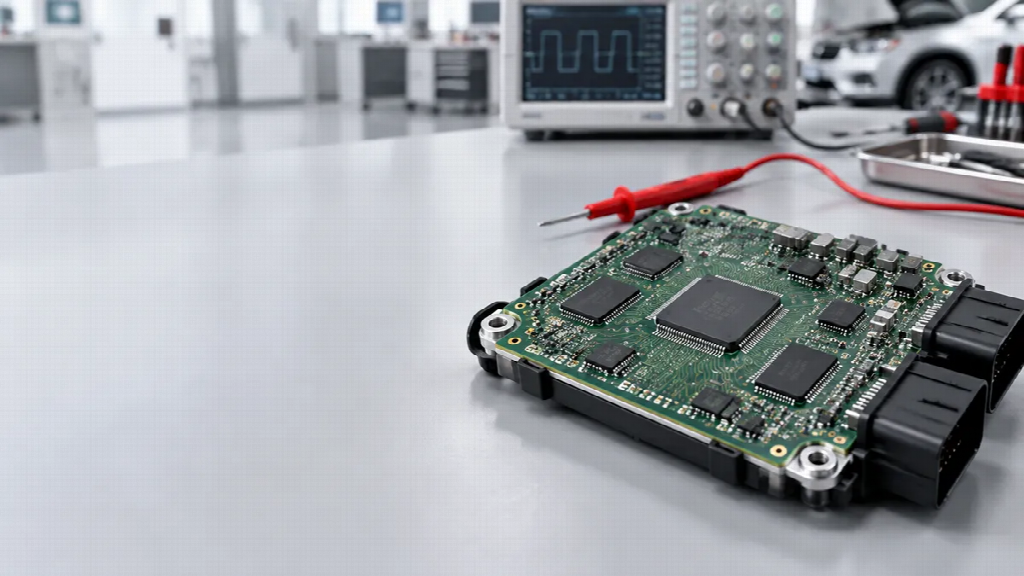
Engineers usually mix them. A vehicle is a clean example. DRAM holds the live sensor and navigation workload. NAND holds maps, logs, and infotainment files. NOR often holds the firmware that has to start the system before anything else is awake.
The mix is the design. Swapping one type for another because it is “newer” usually creates a different failure.
DRAM is the Scratchpad
DRAM only keeps data while power is present. That sounds like a flaw until you look at what processors actually need: a wide, fast path for whatever is happening this millisecond.
That is why DRAM shows up in PCs, phones, servers, and AI systems. The processor is not waiting on a file in storage. It is waiting on the next frame, the next token, the next closed tab you expected to still be there.
On a phone, this is the difference between jumping from camera to chat and back without the camera cold-starting. On a console or PC, it is the difference between a world that streams in and a hitch while assets are fetched again. On a server, it is whether an AI job sits on the GPU or stalls because the working set does not fit.
Capacity still matters, but bandwidth and how the memory is attached matter as much. A device can advertise a large storage number and still feel slow if the working memory is tight.
The supply side is concentrated. A handful of companies set the pace for DDR, LPDDR, and high-bandwidth parts used in phones, PCs, and servers. Hardware teams planning a long product life have to watch those roadmaps, not only the spec sheet in front of them. A current snapshot of major dram manufacturers 2026 is useful here because the vendor list is short and the product families move quickly.
NAND Flash is the Closet
NAND Flash keeps data after shutdown. That is the job behind SSDs, phone storage, memory cards, and a lot of embedded file systems.
It is the reason a phone can hold a camera roll and a laptop can lose the spinning disk. It is also why “256 GB” on a box tells you almost nothing about speed. Two devices with the same capacity can feel different if one moves data through a faster controller and a wider path.
NAND is the wrong tool for some boards. A small industrial controller does not need 512 GB. It needs to find a small block of code quickly, survive power loss, and still boot after five years on a factory floor. Pushing that job onto cheap NAND can work. It can also produce a device that takes too long to start or wears faster than the product life.
So NAND took over consumer storage without taking over every firmware slot.

NOR Flash Still Earns its Place
NOR Flash gets less marketing because it does not win on gigabytes. It wins on a different access pattern.
NOR is good at fast random reads. That makes it a natural home for boot code and firmware that the processor needs to touch immediately, sometimes execute in place, without first copying a large image into RAM. Data retention and a predictable read path matter more here than cost per bit.
That is why NOR still shows up in automotive modules, industrial controllers, networking gear, and other boards that have to start the same way every time. The designer is not trying to store a movie. The designer is trying to make sure the board does not sit in a reboot loop because the boot device was optimized for the wrong thing.
The practical comparison is not “which flash is better.” It is which job you are buying. A short guide to nand vs nor flash is enough to keep those jobs from being collapsed into one line item on a BOM.
What Hardware Teams actually Decide
DRAM generations move fast. A phone designed around one LPDDR version may not have a clean drop-in three years later. NAND packaging and interface options multiply. NOR parts used in industrial and automotive programs can stay in a design longer than consumer DRAM, then go end-of-life while the machine is still shipping.
So the question is not only “does this memory meet the bandwidth target?” It is also:
- Will this density still be made when production ramps?
- Is there a second source with the same package and voltage?
- If the part disappears, is the substitute a redesign or a paperwork change?
Those questions sound like purchasing. They start in schematic review. A board that only works with one memory vendor is a product risk, even if the prototype is fast.
Use Different Memory on Purpose
Consumer devices made DRAM and NAND familiar. Embedded products kept NOR in the mix because boot and firmware are unforgiving. AI and vehicles did not simplify this. They stacked more of each type onto the same system.
The useful habit is to name the job before naming the part. Working set, file storage, and boot code are three problems. They still need three kinds of answers.

Alexia is the author at Research Snipers covering all technology news including Google, Apple, Android, Xiaomi, Huawei, Samsung News, and More.