Inside the Engineering of a Foldable Incline Treadmill
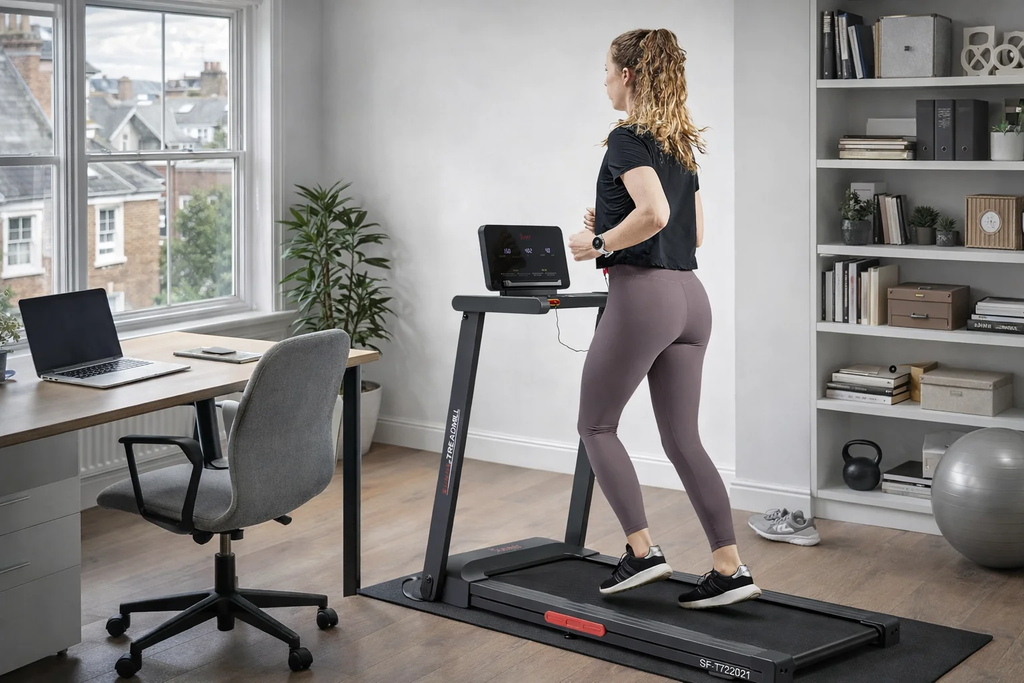
A folding treadmill and a steep incline want opposite things. Incline asks for a stiff, heavy frame that stays planted while you climb. Folding asks for hinges, moving parts and a machine you can roll out of the way.
Putting both into one running treadmill is a long list of trade-offs. This guide walks through where they sit: the lift that tilts the deck, the motor that holds your pace on a slope, the frame and hinge under your feet, and the fold itself. Then it maps what usually changes between budgets of $1,000, $1,500 and $2,000, and ends with a 25-minute hill session for a small room.
Why Incline and Folding Pull in Opposite Directions
A flat folding treadmill mainly has to stay level and quiet. Add a powered incline and the job changes. The deck now tilts on a pivot, a lift mechanism carries your weight at an angle, and every footstrike lands on a surface that isn’t resting flat on the floor.
Folding brings its own demands. A hinge or latch has to lock solid during a run, then release cleanly afterward. The machine needs to be slim enough to store, yet stiff enough not to flex on a climb. Every joint that makes folding possible is one more place where play or wobble could creep in.
That’s why a running machine incline is harder to build into a folding frame than a fixed one. A non-folding treadmill can simply add more steel. A foldable one has to find its stiffness in smarter geometry, tighter tolerances and better materials.
The Lift: What Happens When the Deck Tilts
Incline is measured as grade, meaning how much the deck rises for every 100 units it runs forward. An 18% grade sounds modest. Over a running surface about 51 inches long, though, it lifts the front of the deck roughly 9 inches above the rear pivot, an angle of about 10 degrees.
The lift mechanism, usually a motorized actuator under the front of the deck, has to raise that height with you standing on it. Then it has to hold position while your weight shifts with every stride, without drifting, clunking or creaking.
How fast the grade changes matters as much as how high it goes. Hill intervals only work if the incline can rise and fall within a 1- or 2-minute block. Small steps help too. A lift that moves in fine increments lets you nudge the effort up instead of jumping straight to a grade you can’t hold.
Motor and Belt: Holding Your Pace on a Slope
On a flat deck, the motor mostly works to keep the belt moving under your footfalls. On a slope, the physics shift. Gravity pulls you back down the deck, and each push-off drives the belt in the direction it’s already moving. The motor’s job becomes holding a steady speed while your stride loads and unloads it.
This is where the motor and its speed controller earn their keep. A drive with plenty of continuous power and quick speed correction keeps the belt even through each stride, without surging or hesitating. Brushless motors are popular here because they hold speed precisely, run quietly and have no brushes to wear down.
The deck and belt play a part too. Climbing tends to shift your landing further forward on your foot. Good cushioning softens that landing without feeling spongy when you push off uphill.
Frame and Hinge: Where Stability Is Won or Lost
Stability on a folding incline treadmill comes down to how well the frame resists flex and twist. At a steep grade, the raised deck is carried by its lift supports, while running strides load it hard and fast. Any weakness shows up as bounce underfoot or a faint shake through the handrails.
Engineers counter this with reinforced side rails, broad supports under the lifted section, and latches that clamp the fold joint tight. Weight capacity is a useful outside clue. A machine rated for heavier users usually has a stiffer frame, which leaves more margin when anyone climbs at speed.
Handrails need the same thought. Side handles help you steady yourself between hard efforts, and on compact machines they should fold with the frame so the stored size stays small.
The Fold: Weight, Wheels and Controlled Motion
A treadmill sturdy enough for incline running will never be featherweight. So a good fold is less about lifting and more about guiding that weight safely. Look for a lock you can release in one step, transport wheels paired with a sensible handle, and parts that can’t drop suddenly.
Controlled motion is the detail you notice once you own one. A handrail that lowers on a damped hinge can’t slam onto the floor or pinch fingers. A machine that arrives fully assembled also saves you from bolting a heavy frame together yourself, and the frame is the part that keeps you steady.
Folded size decides where the treadmill lives. Measure the wall, closet corner or hallway spot before you buy. A deck that folds in half and stands upright takes far less floor than it covers when open.
What Your Budget Buys: Under $1,000, $1,500 and $2,000
Powered incline now shows up even on lower-cost folding treadmills. What changes as the price climbs is how well a machine holds that grade at speed, how solid it feels near the top of its range, and how easily it folds away. Treat these tiers as general patterns rather than fixed rules. When you shortlist foldable running treadmills, compare incline range, top speed and folded size side by side.
| Budget | Incline you’ll often see | Motor and drive | Frame and deck | Folding | Best fit |
| Under $1,000 | Powered incline, often up to 10–15% | Smaller motors, suited to walking and easy jogging on a climb | Lighter frames; compact models often have shorter decks | Deck lifts up or folds flat, usually with a spring assist | Incline walking and short jogs |
| Under $1,500 | Similar or wider range, with smoother grade changes | More continuous power and steadier belt speed under load | Stiffer frames, more cushioning, higher weight ratings | Assisted folding with sturdier locks | Regular incline walks plus steady runs |
| Under $2,000 | Steeper ranges, sometimes 15% and beyond, in finer steps | High-output brushless drives that hold running speeds on a climb | Reinforced frames that stay steady across the full range | Compact folding that keeps a running-length deck, often with upright storage | Hill intervals and incline running in a small space |
The top tier is where engineers stop choosing between a steep climb at running speed and a machine that tucks into a corner. The WalkingPad G5i is a foldable incline treadmill built around that brief. Its 18% auto incline moves across 25 levels, so each step is small enough for gradual progress.
A 4.5 HP brushless motor carries it from an easy 1 mph walk to a 10 mph run, and the frame is rated for users up to 300 lb. When the session ends, the deck folds in half and the machine stands upright against a wall, about 10.2″ deep. Choose a lower tier if you mostly walk at incline. Look at this tier if you want to run hills at home.
Putting It to Work: A 25-Minute Hill Session
A steep incline lets a compact machine deliver a hard workout without a long stride or a high top speed. A brisk walk at a steep grade can ask as much of your heart and legs as an easy run on flat ground.
| Minutes | Incline | Speed | How it should feel |
| 0–5 | 0–2% | Easy walk, 2.5–3 mph | You can talk in full sentences |
| 5–20 | 5 rounds: 2 min at 8–12%, then 1 min at 1–2% | Brisk walk, 3–3.5 mph; runners can jog the easy minute | A few words at a time on the climbs |
| 20–25 | 0–2% | Easy walk | Your breathing settles |
- New to incline: Keep the climbs at 5–6% for the first couple of weeks, then add 1–2% at a time.
- To progress: Add one round, or raise the grade before you raise the speed.
- Form and safety: Clip on the safety key, stand tall and keep a light touch on the rails. Lower the incline before you slow down and step off.
Two or three sessions like this a week, with easy walks in between, is plenty for most people. Stop if you feel dizzy, unusually short of breath or any joint pain.
Final Thoughts
A foldable incline treadmill is a set of answers to competing demands. A quick, precise lift and a motor that holds your pace on a slope shape every climb. A steady frame and a fold you can manage alone shape everything around it.
Start with how you’ll use the incline, walking or running, and pick the budget tier that matches. The right machine is the one you’ll unfold, climb on and put away without a second thought.

Alexia is the author at Research Snipers covering all technology news including Google, Apple, Android, Xiaomi, Huawei, Samsung News, and More.