TU Berlin: Researchers crack Windows Hello PIN protection using brute force

Researchers at the Technical University of Berlin have developed a method that can be used to bypass PIN entry on Windows using a brute force attack. The team connects a chip that bypasses the TPM’s protective functions.
Lock for repeated PIN entries ineffective
Security researchers at TU Berlin used a “chip-in-the-middle” method to circumvent the increasingly long waiting time for further entries when incorrect PIN entries are made under Windows and were thus able to “guess” the PIN on Windows PCs after a comparatively short time using brute force attacks. In their method, the team uses interposer hardware to exploit implementation errors made by manufacturers or suppliers of Trusted Platform Modules (TPM) in their anti-hammering protection. The latter is actually intended to ensure that a longer waiting time is necessary after an incorrect PIN is entered, which makes a large number of new attempts simply impractical.
Gaps in implementation exploited
Like the researchers documented in their paper the anti-hammering protection often implemented on modern PCs as part of the SPI flash in the form of so-called Replay Protected Monotonic Counters (RPMCs) can be circumvented with their method with some effort but little cost.
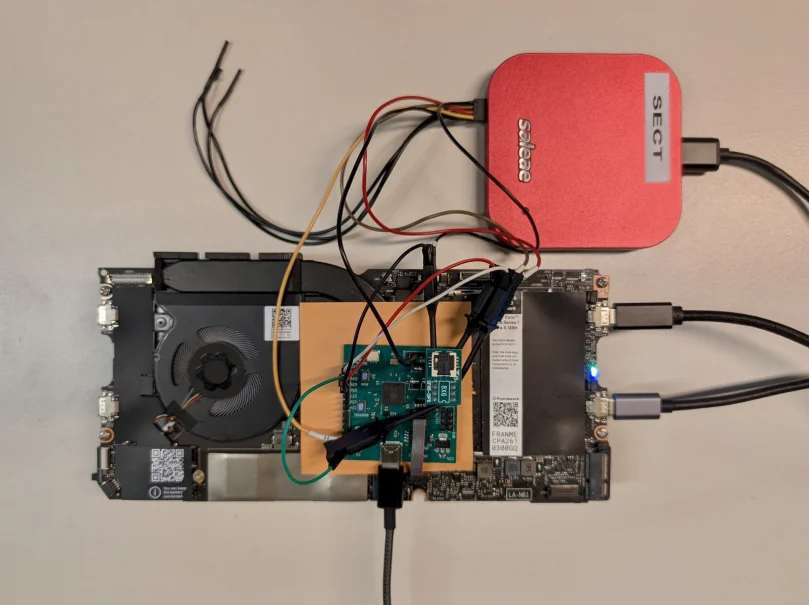
The two fundamental vulnerabilities that made it possible to find the Windows Hello PIN within 40 hours instead of 69 days (for a four-digit PIN) and 20 days instead of 19 years (for a six-digit PIN) each consist in the possibility of quickly resetting the lock counter for re-entering the PIN.
AMD, Intel & Microsoft react differently
With Intel-based systems, 34.1 PIN entries per minute could be made using the Berlin researchers’ methods, while with AMD systems there was an average of only 4.14 PIN entries per minute. For an attacker, the effort must be worthwhile, as it takes a lot of time in addition to the relatively inexpensive hardware. According to the paper, the systems tested by the researchers with their attack methods were four AMD and five Intel-based x86 PCs, which included a sixth-generation NUC, three “normal” desktop computers and laptops from manufacturers such as Framework, HP, Acer, Lenovo and Asus. AMD has already responded to the findings of researchers from the TU Berlin and has promised to deliver firmware updates between November 2026 and February 2027 to close the underlying security gaps.
However, it is up to the respective PC and motherboard manufacturers to pass the updates on to users. Intel does not see itself as having any obligation and instead refers to the suppliers of the SPI flash chips, who should make appropriate adjustments in order to eliminate the vulnerabilities documented by the researchers in the Security in Telecommunications department at the TU Berlin. According to the TU Berlin, Microsoft wants to respond with the recommendation that users should always provide their computers with a six-digit PIN for Windows Hello.

Research Snipers is currently covering all technology news including Google, Apple, Android, Xiaomi, Huawei, Samsung News, and More. Research Snipers has decade of experience in breaking technology news, covering latest trends in tech news, and recent developments. Can be reached at author1@researchsnipers.com