1.1 million MacBook Neo: Apple takes over the entry-level segment

Apple’s MacBook Neo gets off to a strong start: 1.1 million sales in just three weeks – and suddenly Apple is shaking up the entry-level laptop market. Only Apple would probably have expected this, the competition is more likely to be surprised.
The Neo hits the nerve of the buyer group
A few months after its market launch, Apple’s MacBook Neo is becoming one of the most exciting experiments in the notebook market – and apparently hits the right nerve with a new group of buyers. According to IDC, Apple sold around 1.1 million devices in the first sales quarter, in which the device was only available for around three weeks.
The Neo not only outperformed the MacBook Air with M5, which was launched at the same time (900,000 units), but also left the MacBook Pro well behind. The MacBook Neo in the video: 13 inches, A18 Pro chip & Apple Intelligence
Delivery bottlenecks could not be avoided
What is striking is less the sheer number than the speed at which the device is spreading. Industry observers report that demand picked up noticeably at the beginning of April – shortly after the actual market launch in mid-March. In April, Apple itself spoke of an “extraordinarily high” response and at the same time confirmed delivery bottlenecks. The approach behind the MacBook Neo is clear.
Apple wants to make entry into the Mac world significantly cheaper and thus reach target groups that have previously preferred Windows notebooks or Chromebooks. With a starting price of around 600 US dollars, the device is significantly lower than the MacBook Air – while at the same time using a familiar design language. Aluminum housing, 13-inch Liquid Retina display and macOS continue to provide the typical Apple feeling.
Compromises
However, to achieve this price, Apple consciously makes compromises. Instead of an M chip, an A18 processor from the iPhone series works inside; the basic version has 8 GB of RAM available. Users also have to accept compromises when it comes to the connection equipment and individual components such as the touchpad. At the same time, Apple partially uses chips that were originally unable to activate all GPU cores – an efficient way of dealing with production waste.
Apple’s entry-level models have changed
The fact that this strategy works is particularly evident in price-sensitive markets. In India, for example, demand quickly exceeded the available quantities. At the same time, the role of older, discounted MacBook Air models, which previously served as a cheaper entry-level model, is shifting. The Neo could take over this position in the future.
Another effect: Apple says it is gaining more new Mac customers than ever before in a quarter. Market analysts see this as a strategic turning point. The company is penetrating price ranges in which Macs were previously rarely represented. Apple’s share in the segment between around $400 and $700 is currently only around 2 percent – in the long term, this value could increase significantly thanks to the Neo.
Apple MacBook Neo – technical data in comparison
| Feature | MacBook Neo (Basic) | MacBook Neo |
| chip | Apple A18 Pro, 6-core CPU (2 performance cores, 4 efficiency cores), 5-core GPU, 16-core neural engine | |
| display | 13 inch Liquid Retina, 500 nits, 1 billion colors | |
| SSD storage | 256GB | 512GB |
| RAM | 8GB | |
| Battery life | up to 16 hours | |
| Connections | 2x USB-C (1 x USB 3, 1x USB 2), 3.5 mm jack | |
| WiFi/Bluetooth | Wi-Fi 6E, Bluetooth 6 | |
| input | Multi-Touch Trackpad, Magic Keyboard | Multi-Touch Trackpad, Magic Keyboard with Touch ID |
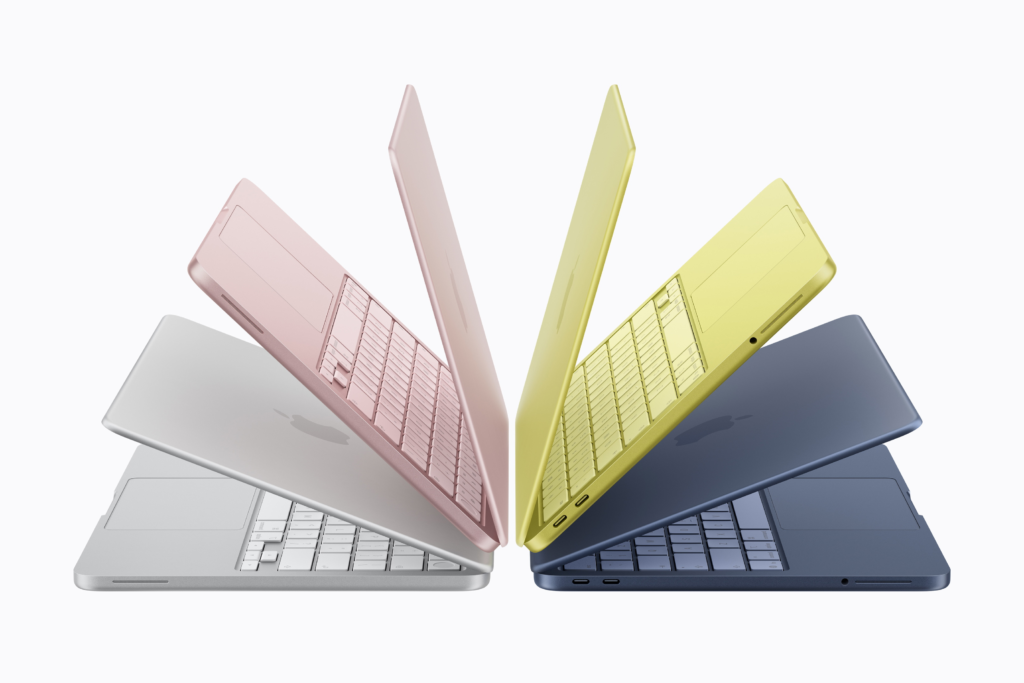
| Colors | Silver, pink, citrus, indigo | |
| Dimensions | 29.75cm x 20.64cm x 1.27cm | |
| Weight | 1.23kg | |
| Price | 699 euros | 799 euros |
Growing demand
The competition is already reacting. Manufacturers like Dell are specifically positioning new devices in this price range and openly refer to the growing demand for comparatively inexpensive but high-quality notebooks – a segment that Apple is now actively helping to shape with the MacBook Neo.