Managing DTF Transfer Orders Across Multiple Cincinnati Apparel Projects
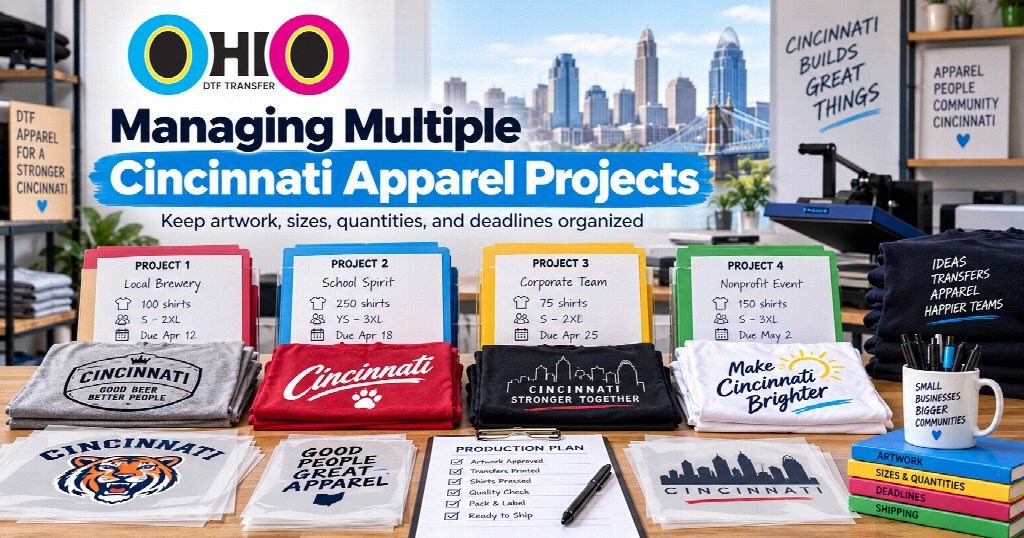
Cincinnati’s official September 2026 special-events calendar places very different projects within the same few weeks: neighborhood block parties, corporate runs, community events, sports-related gatherings, and major city festivals. The calendar does not measure demand for custom apparel or DTF transfers, but it illustrates a practical local challenge: businesses, organizers, and apparel producers can be managing several branded projects with different audiences and deadlines at once.
When apparel jobs overlap, the main risk is losing the boundary between projects. Artwork from one campaign can be paired with the wrong quantity, a size list can land in the wrong order, or a deadline can become separated from the production details behind it. A cleaner system treats each project as its own production package before any transfer order is released.
Give Every Apparel Project Its Own Order Identity
Assign each job a simple project name or internal ID. The label should identify the job without requiring anyone to open every file. A useful identifier can combine the client or organization name, project purpose, and needed date.
The goal is not complicated project-management software. It is one reference point that follows the job from artwork preparation through transfer ordering and apparel production.
- Project: What campaign, event, team, department, or merchandise job is this?
- Artwork: Which final design files belong to it?
- Transfer sizes: What dimensions are required?
- Quantities: How many transfers are needed at each size?
- Garments: Which apparel items will receive them?
- Needed date: When must the finished apparel be ready?
Keeping those details under one project identity makes it harder for information from two active jobs to blend together.
Keep Artwork, Size, and Quantity Decisions Together
Problems appear when artwork is stored in one place, quantities in another, and transfer dimensions in a message thread. Each detail may be correct by itself, yet the production package can still be wrong if those pieces do not match.
For every design, record the final file, intended transfer size, and quantity as one line item. If the same logo will be used in more than one size, treat each size as a separate production requirement. If two projects use similar artwork, do not assume the files are interchangeable. Project-specific text, dates, names, or placements can make visually similar files different production assets.
A clear project record lets the person placing the order verify what belongs together instead of reconstructing the job from memory.
Plan Around the Finished-Apparel Deadline
The date that matters is not simply when transfers should arrive. The real deadline is when the finished apparel must be ready for use, distribution, photography, staff deployment, or an event.
Work backward from that point. Leave room for receiving the transfers, pressing the garments, checking finished pieces, sorting sizes, and correcting an issue discovered before handoff. Two projects with the same transfer order date may still need different production schedules if one is a small staff run and the other requires many garments to be sorted for separate recipients.
Do not combine projects only because their dates are close. Combine steps only when doing so preserves a clear connection between artwork, quantities, transfer sizes, and the finished-apparel deadline.
Choose the Ordering Method Project by Project
Different projects may benefit from different transfer-order formats. A job with several approved graphics and repeated designs may be organized as a gang sheet. Another job with a small number of designs in defined dimensions may be easier to manage as transfers ordered by size.
The choice should follow the artwork and production plan, not the fact that several jobs are active at the same time. Forcing every project into one shared ordering method can make the order harder to audit later.
When reviewing DTF transfers in Cincinnati, compare the available ordering paths against each project separately. Ask which order structure makes each finished apparel job easiest to verify and produce correctly.
Keep Similar Designs From Becoming Duplicate Mistakes
Multiple campaigns can reuse logos, sponsor marks, department names, or recurring graphics. Reuse can save design time, but it can also create false duplicates. A familiar-looking file may contain a different date, revised text, another print size, or a different placement requirement.
Compare similar designs inside the context of their own project. Confirm the filename, visible text, transfer dimensions, and quantity. If a shared logo truly is identical across several jobs, note that intentionally rather than assuming it. This helps prevent an old file from being treated as current simply because it looks almost the same.
Use a Final Project-by-Project Release Check
Before submitting transfer orders, review each project independently. A short release check should answer six questions:
- Is this the final artwork for this specific project?
- Are the transfer dimensions correct for the intended garments?
- Do the quantities match the current production plan?
- Is the ordering method appropriate for this artwork set?
- Does the schedule leave enough time to press and inspect the apparel?
- Can every line item be traced to the correct project?
Only after each job passes its own check should you look for sensible ways to streamline purchasing or production. Organization should come before consolidation.
Make Parallel Cincinnati Apparel Work Easier to Control
Managing several apparel projects at once does not require an elaborate system. It requires clean boundaries. Give each project its own identity, keep artwork tied to size and quantity decisions, plan from the finished-apparel deadline, and choose the transfer-order format that fits that specific job.
This approach is useful when local business campaigns, community activities, staff needs, and event timelines overlap. Every transfer should have an obvious destination before production begins. When another person can follow the project record without guessing, the apparel workflow becomes easier to review, hand off, and complete.

Alexia is the author at Research Snipers covering all technology news including Google, Apple, Android, Xiaomi, Huawei, Samsung News, and More.