Thermodynamic Constraints and Process Engineering in Direct Air Capture Scalability
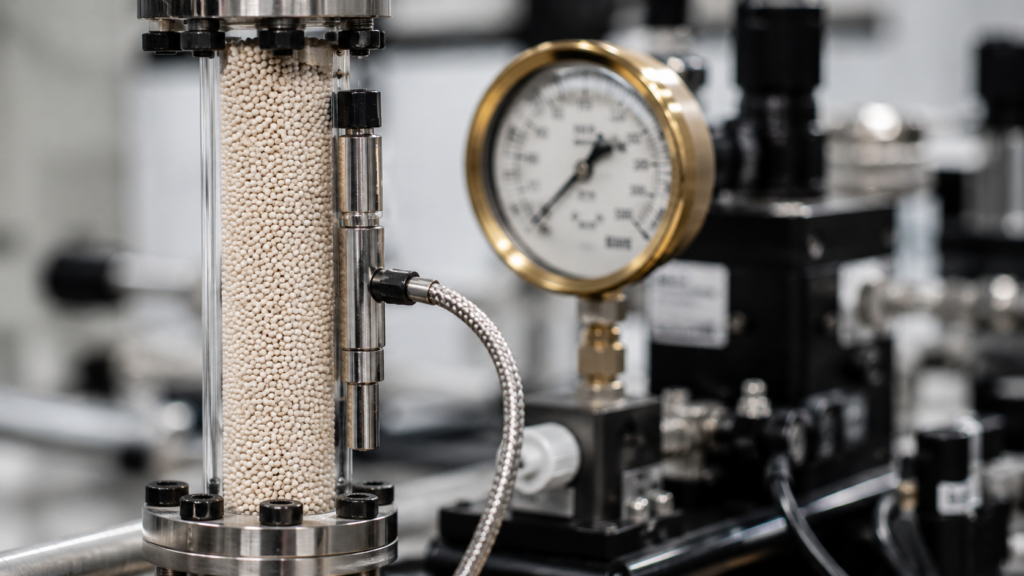
Atmospheric carbon dioxide mitigation has transitioned from a theoretical environmental objective to a rigorous discipline within chemical and process engineering. Among the engineered pathways under development, Direct Air Capture (DAC) represents a technologically distinct approach due to its ability to extract carbon dioxide directly from ambient air. However, the primary bottleneck of these systems lies in the profound thermodynamic penalties associated with separating a trace gas from the atmosphere. With global concentrations hovering around 420 parts per million (ppm), the chemical separation process requires exceptionally high selectivity and optimized mass transfer mechanisms to achieve operational and economic viability.
For research institutions and university faculties, evaluating DAC scalability requires moving beyond basic computational fluid dynamics (CFD) models toward physical, modular laboratory infrastructure capable of isolating operational variables under real-world conditions.
1. Mass Transfer Kinetics and Chemical Sorption Mechanisms
The primary engineering challenge of DAC is the sheer volume of air that must pass through the contactor phase. Industrially, the implementation of this specific co2 removal technology is bifurcated into two core methodology pathways: liquid solvents (typically aqueous basic solutions like potassium hydroxide) and solid sorbents (commonly amine-functionalized porous materials). Liquid systems utilize a continuous absorption loop where carbon dioxide reacts with the alkaline solution to form a carbonate salt, offering high reaction rates but suffering from evaporative water loss.
Conversely, solid sorbent systems utilize porous matrices that bind carbon dioxide through chemical sorption (chemisorption). The performance of these contactors is heavily governed by the mass transfer rate (N), which can be quantified in data analysis loops via the relation:
Mass Transfer Rate (N) = K * A * (C_bulk – C_interface)
Where K represents the overall mass transfer coefficient, A is the active surface area of the contactor, and C represents the concentration gradients. In academic research laboratories, evaluating the variables that influence K and A is paramount to analyze how air velocity and relative humidity alter the boundary layer resistance at the sorbent interface.
2. Process Control and Regeneration Energy Cycles
The economic viability of any DAC facility is determined during the desorption or regeneration phase. Because the chemical bonds formed during adsorption are stable, significant thermal or barometric energy must be injected into the system to release the captured carbon dioxide. Most solid sorbent systems rely on Temperature-Vacuum Swing Adsorption (TVSA) cycles, where the sorbent bed is sealed, a vacuum is drawn, and the temperature is elevated between 80°C and 120°C.
This cyclic thermal stress introduces complex process control challenges, such as minimizing thermal degradation of the amine matrix and managing pressure fluctuations to prevent rapid transients that could structurally damage the matrix. The thermal regeneration efficiency (eta) of an adsorption bed can be determined through the empirical evaluation of the energy input against the mass of gas desorbed:
Thermal Efficiency (eta) = (Mass of Desorbed CO2 * Heat of Adsorption) / Total Thermal Energy Input * 100
Validating this efficiency requires laboratory setups equipped with high-accuracy flow meters, temperature sensors, and proportional-integral-derivative (PID) control loops capable of managing rapid thermal shifts without causing system instability or structural breakdown of the sorbent material.
3. Laboratory Validation and Micro-grid Integration
For advanced engineering departments, software simulations often oversimplify the transient behavior of adsorption columns. Localized temperature gradients, fluid channeling, and competitive adsorption with atmospheric moisture can only be evaluated through empirical observation to meet ABET educational outcomes.
Advanced technical teaching systems, such as the engineering platforms designed by EDIBON, allow university laboratories to isolate these parameters by integrating real-time data acquisition and industrial SCADA systems. This supervisory software enables high-speed data logging, advanced process diagnostics, and real-time visualization of thermodynamic cycles. Furthermore, modern research focuses on coupling DAC units with autonomous Renewable Energy Micro-grids. This requires sophisticated Energy Management Systems (EMS) that can dynamic-load-schedule the regeneration cycles to coincide with peak solar or wind generation periods, optimizing localized energy storage and mitigating grid frequency instability.
4. Industrial Scalability and Future Engineering Benchmarks
The transition of Direct Air Capture from a laboratory concept to a gigaton-scale solution depends entirely on resolving core challenges in mass transfer efficiency and process automation. Theoretical thermodynamics provide the boundaries, but practical systems engineering determines the feasibility of carbon capture infrastructure.
By prioritizing advanced curriculum design that emphasizes grid integration, SCADA control, and experimental validation, universities can ensure their graduates possess the professional proficiency required for the modern industrial workforce. Scalable, research-grade platforms provide the necessary physical infrastructure to transform theoretical models into robust, industrial-strength applications, fostering innovation in the global pursuit of grid resilience and sustainable chemical engineering.

Alexia is the author at Research Snipers covering all technology news including Google, Apple, Android, Xiaomi, Huawei, Samsung News, and More.