3 Leading SD-Wan Solutions Every Multi-Site SME Should Know
A regional finance firm adds its seventh office, moves several workloads to the cloud, and keeps its existing broadband contracts to control costs.
Six months later, voice calls break up, branch policies have drifted, and the IT team can’t quickly tell whether an application failure sits with the ISP, the cloud service, or the local network.
That’s the point at which SD-WAN solutions become an operational decision rather than a network refresh.
For multi-site SMEs, the right choice should improve application routing, preserve security controls across branches, and reduce the amount of manual work attached to every new location. Price matters. So does what happens at 2 a.m. when a circuit fails.
What Multi-Site SMEs Should Expect From SD-WAN
Traditional WAN designs often send branch traffic back through a central data center before it reaches cloud applications. That made sense when most systems lived on company-owned infrastructure. It’s much harder to defend when staff depends on SaaS platforms, video meetings, hosted voice, and cloud workloads throughout the day.
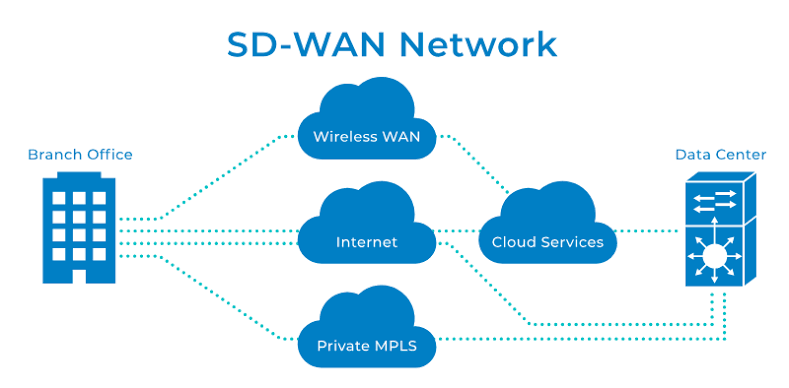
SD-WAN applies centrally defined policies to available connections such as broadband, fiber, 5G, and MPLS. Traffic can be directed according to application requirements and current link conditions instead of relying only on static routes.
The business case isn’t limited to connectivity. The UK government’s SME Digital Adoption Taskforce update describes digital adoption as a route to higher productivity.
Yet each new digital service adds another dependency on branch connectivity. A slow or unstable WAN quietly eats into the gains those tools were meant to create.
The following options represent three practical ways an SME can approach that problem.
1. SD-WAN Services for Distributed Networks
Many organizations prefer SD-WAN services that combine routing, traffic steering, policy enforcement, and security capabilities within a unified management framework. This approach can reduce operational overhead and simplify branch connectivity across distributed environments.
That consolidation matters to smaller infrastructure teams. When networking and security policies sit in separate products, a simple branch change can bounce between engineers, consoles, and support contracts. Misalignment creeps in. Sometimes nobody spots it until an incident review.
SD-WAN services in this category are often suited to SMEs that need:
- Physical or virtual deployment choices across different branch types
- Application-aware path selection
- Central policy and configuration management
- Integrated firewall and threat inspection controls
- Support for broadband, MPLS, LTE, and 5G connections
- A possible path from branch SD-WAN toward broader secure access service edge services
A business preparing to deploy reliable SD-WAN solutions today should still run a proof of concept. Service integration doesn’t remove the need to test real traffic, older applications, encrypted sessions, or undersized branch circuits.
Start with awkward sites, not the head office. Pick a small warehouse with unreliable broadband, a busy sales office using hosted voice, and a branch that depends on a latency-sensitive application. If the service performs there, the result tells you far more than a tidy lab demonstration.
2. A Managed SD-WAN Service
Some SMEs don’t want another platform to operate. They want an accountable service provider to supply circuits, configure edge devices, monitor performance, and handle escalation when links deteriorate.
That can be a sensible answer for a company with dozens of small sites and a lean IT team. It can also become frustrating if responsibilities aren’t written down properly.
Who owns the incident when the application is reachable but painfully slow? The carrier may say the circuit is healthy. The cloud provider may report no fault. Internal IT sees users waiting. Without shared telemetry and a clear escalation path, the ticket circles for hours.
Before signing, check:
- Whether the SME retains access to performance and security logs
- Who controls policy changes and how quickly they’re completed
- Whether failover is actively tested or merely configured
- What happens when a site changes carrier
- How monitoring distinguishes application trouble from circuit trouble
- Whether configuration data can be exported when the contract ends
- Which security events reach the internal SOC or external MDR team
That final point deserves attention. Managed connectivity isn’t the same as managed detection. Organizations weighing outsourced security operations can use this MDR and XDR comparison to separate network management from threat investigation and response.
3. Cloud-Managed SD-WAN
A cloud-managed model places orchestration and policy control in a hosted management plane. Branch appliances still handle local traffic, but administrators can provision sites and review network health without maintaining the central controller infrastructure themselves.
This option fits distributed SMEs that open sites quickly or lack a large data center footprint. Retailers, clinics, professional services firms, and growing logistics businesses may find the deployment model particularly practical. A preconfigured appliance can be shipped to a site, connected locally, and brought under central policy with limited hands-on work.
There’s a trade-off, though. Cloud management can simplify administration while creating dependency on the provider’s portal, licensing structure, and service availability. Buyers should ask how local forwarding behaves if access to the management plane is interrupted. They should also examine administrator authentication, audit records, role separation, software updates, and configuration recovery.
Security shouldn’t begin after procurement. The ENISA Secure by Design and Default Playbook sets out repeatable secure-by-design practices for SMEs. That principle applies neatly here: restrictive defaults, controlled administrative access, traceable changes, and planned lifecycle management are far safer than fixing gaps after rollout.
Test the Operating Model, Not Just Throughput
A polished throughput figure won’t show how the network behaves during a messy Tuesday morning. Run failure tests before rollout:
- Disconnect the primary circuit during a voice call.
- Add latency and packet loss to a secondary link.
- Block access to the management service.
- Push an incorrect policy, then measure rollback time.
- Confirm that branch logs reach the monitoring team.
- Test an application whose traffic is encrypted or difficult to identify.
- Record who receives each alert and who has authority to act.
Also calculate total operating cost across three years. Include appliances, subscriptions, circuits, installation, support, training, spare units, and staff time. Cheap hardware paired with constant manual intervention isn’t cheap for long.
Choosing SD-WAN Solutions Around Business Risk
The best choice depends less on branch count than on operating reality. An SME with skilled network and security staff may prefer’s integrated approach and keep direct control.
A smaller team may favor a managed service. A cloud-first business opening sites at speed may put simple provisioning above controller ownership.
Whatever the model, SD-WAN solutions should be assessed against failure behavior, security policy consistency, visibility, and the effort required to keep every branch in step. The real test isn’t whether traffic moves during a sales demonstration.
It’s whether the business can still take orders, serve customers, and investigate suspicious activity when a carrier fails, and nobody from the network team is standing beside the branch appliance.

Alexia is the author at Research Snipers covering all technology news including Google, Apple, Android, Xiaomi, Huawei, Samsung News, and More.