Tank vs. Tankless Water Heaters: Which is the best in Edmonton Winters?
When it comes to selecting a water heater in Edmonton, it is not about selecting the latest technology but rather knowing how each system will perform in the harsh winter conditions. Having temperatures that can drop far below freezing, families require a consistent supply of hot water and maintain energy consumption and maintenance at a reasonable level.
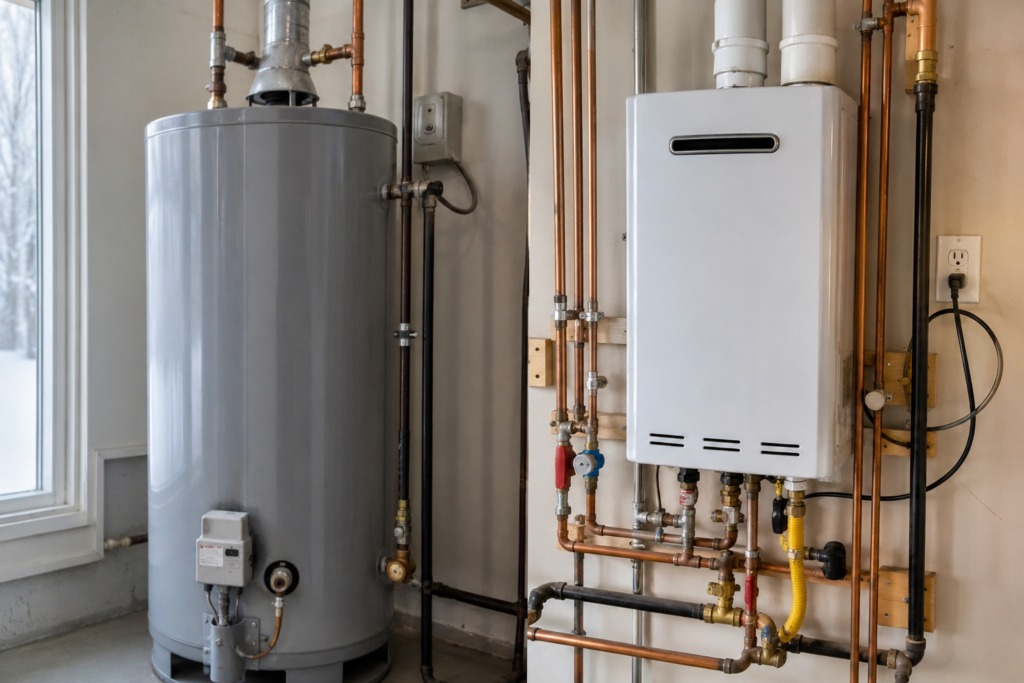
The two most popular are the traditional tank water heaters and tankless, or on-demand, systems. Both are effective, yet they are different and have different benefits based on the home, household size and hot-water needs.
Conventional Tank Water Heaters: Basic and Uncomplicated
A traditional water heater maintains a supply of hot water that can be used. When one opens a shower or faucet, the tank pulls out hot water and replenishes it with cold water coming in.
Predictability is the key benefit. A well-sized tank can supply a constant supply to households that frequently require hot water to shower, wash clothes, wash dishes and other tasks simultaneously.
The disadvantage is that the water must be kept hot even when no one is using it. This may lead to standby energy losses. Another thing that can happen to a tank is that it may run out of hot water when the demand is higher than the capacity of the tank and it takes time to heat another supply.
Another consideration is age. Performance may eventually be impacted by sediment build-up, corrosion and worn parts. Homeowners who have uneven temperatures, strange sounds or leaks might have to check the state of the system instead of merely turning the thermostat.
Tankless Systems: On-Demand Water Heating
Tankless water heaters do things differently. They do not hold a large amount of hot water but heat water as it flows through the unit.
This removes the standby losses of having a tank of hot water and can supply unlimited hot water provided the system is large enough.
However, “continuous” does not necessarily mean unlimited. A tankless system has a limit to the flow rate and multiple showers or appliances running at the same time can overload the system.
This can be especially applicable to Edmonton cold incoming water in winter. The colder the water that is introduced into the system, the more energy is needed to heat it to the desired temperature. This means that homeowners must take into account the output of the unit and the maximum demand of the household instead of selecting a system based on its claimed efficiency.
Climate Changes the Calculation in Edmonton
Climate is a significant aspect of the choice. Water that gets into a home in a cold weather city can be much colder in winter than in warmer seasons. That influences the intensity of work that a tankless heater has to perform to provide hot water at the required temperature.
A traditional tank, in its turn, already contains a reservoir of hot water. Its storage capacity can offer a certain degree of flexibility during high demand times, but the system still must continuously heat water as it is used.
In either technology, the quality of installation, insulation, maintenance and proper sizing may be as practical as the kind of heater itself.
Which of the Two Makes More Sense?
There isn’t a universal answer. A tank water heater can be a good choice when the homeowner appreciates simplicity, reliability of hot-water supply and a system that is familiar and can meet the needs of the typical household without complex planning.
A tankless system can be attractive to families with a small area or those who are concerned about minimizing standby energy waste. It may also be reasonable when the pattern of hot-water consumption in the household and the electrical or gas infrastructure of the home is compatible with the equipment.
The purchase price should not be the only cost to calculate. The long-term economics can be affected by installation requirements, fuel or electricity consumption, maintenance, anticipated service life and possible repairs.
Don’t Ignore the Repair Question
Regardless of the system that a homeowner adopts, reliability ultimately becomes more valuable than the technology. An inefficient water heater may fail or become inefficient due to improper maintenance.
It may be worthwhile to have a qualified technician identify whether the issue is a repairable part, a sediment issue, a control problem or an indicator that the system has reached the end of its useful life before replacing an existing unit. Hydro-Flo water heater repair is one of the examples of the local service that homeowners can explore in case they have an existing problem.
The Bottom Line
In the case of Edmonton homeowners, the more appropriate option is based on the infrastructure of the home and the real hot-water usage of the household.
Tankless technology has the potential to provide efficiency and space benefits, but must be properly sized to cold weather conditions and peak demand. Conventional tanks are still a viable choice due to their simple design and the possibility of holding a ready supply of hot water.
Instead of making a decision based on the newer technology or the lowest initial cost, homeowners need to compare capacity, winter performance, installation needs, energy consumption, maintenance and long-term repair expenses. That larger calculation will yield a more useful answer in the climate of Edmonton than merely deciding between tank and tankless.

Alexia is the author at Research Snipers covering all technology news including Google, Apple, Android, Xiaomi, Huawei, Samsung News, and More.